
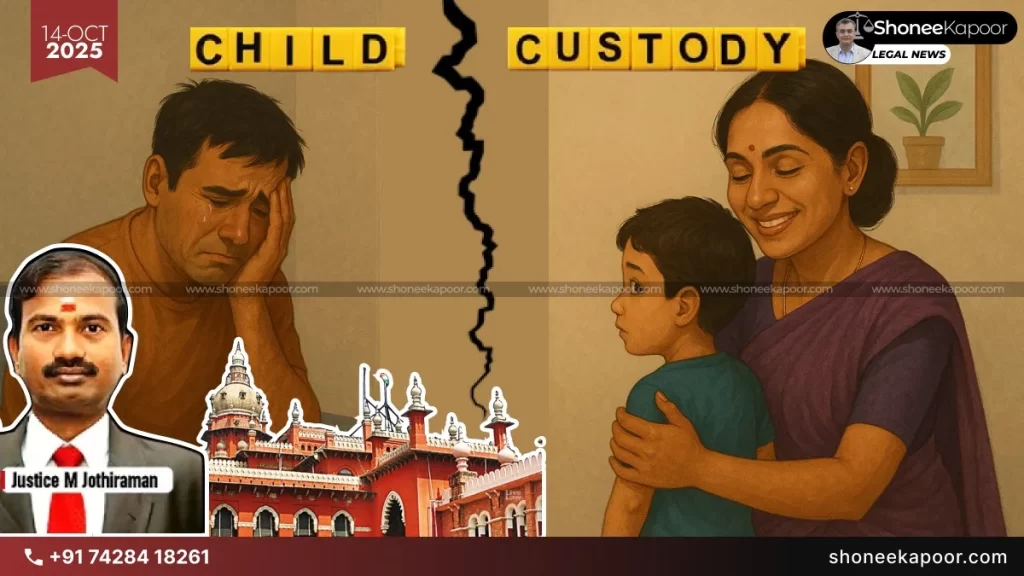
The Madras High Court ruled that a father’s visitation rights must not interfere with his child’s education or emotional well-being. The Court modified the visitation order to ensure the 8-year-old’s best interests are fully protected.
CHENNAI: The Madras High Court has recently said that while a father has the right to meet his child, this right must never harm or disturb the child’s schooling, physical, moral, emotional, or intellectual growth.
The Court gave this decision while changing a lower court’s order that allowed the father to meet his minor daughter in Chennai — a place far from where the mother and child live.
Justice M. Jothiraman, sitting as a Single Bench, said:
“The Court has to ensure visitation rights to the biological parents in a manner known to law. When the custody of the child is entrusted to one of the parents, well being of the child should be taken into consideration while granting the right of visitation to another. Welfare of the child alone is of paramount consideration while dealing with cases pertaining to grant of visitation rights. No doubt the respondent / father is entitled for visitation rights, but at the same time, it should not disrupt the child’s schooling, physical, moral, emotional and intellectual development.”
The case came before the High Court after the wife challenged the lower court’s decision. The wife had earlier filed for divorce under Section 13(1)(i-a) of the Hindu Marriage Act, 1955, and also asked for ₹75,00,000 as permanent alimony under Section 25 of the same Act.
While that case was still pending, the husband filed an application under Section 26 of the Act, requesting the right to visit his minor daughter. The lower court partly allowed his request and directed that the child be produced at the Child Care Centre, Family Court, Chennai, on the first and third Saturdays of every month.
However, the wife — living in Hosur and working in Bangalore — found it difficult to travel all the way to Chennai every month with her 8-year-old daughter. Therefore, she filed a Civil Revision Petition before the Madras High Court.
After carefully studying the facts, the Court observed that the minor child lives with her mother in Hosur, while the father resides elsewhere. Justice Jothiraman noted that making an 8-year-old travel such a long distance repeatedly could cause physical and psychological stress.
The Court stated:
“In cases involving minor child particularly visitation rights or welfare matters, the Court’s paramount consideration should be to secure the best interest of the child. The Court’s primary concern is to ensure that the child’s physical, emotional and psychological well being is not disturbed. The child interest take precedence over those of the parents/guardians. The Court has to consider the child’s age, needs and requirements. The Court also should assess the ability of the parents to provide suitable environment. Age of the child, maturity and her wishes to be taken into account.”
The Bench also referred to Article 51-A(k) of the Constitution of India, which says that every parent or guardian must provide educational opportunities to children between the ages of six and fourteen years.
Taking this into account, the Court said:
“This Court has to carefully consider the child’s best interest and to take a decision promoting her welfare and development. Considering the age of the child, physical and psychological hardship she would face, if she is permitted to travel from Hosur to Chennai in order to facilitate the respondent’s visitation rights as per the order of the Court below and also the apprehension of threat expressed by the respondent/father, this Court is inclined to modify the condition imposed by the Court below.”
Finally, the Madras High Court modified the earlier order. It ruled that instead of the mother and child travelling to Chennai, the father should visit his daughter at the Child Care Centre attached to the Family Court at Krishnagiri, which is much closer to the child’s home.
The Court concluded by saying:
“In all other aspects, the order of the Court below remains unaltered.”
Explanatory Table — Laws & Sections Mentioned
| Provision / Case | Description & Purpose |
|---|---|
| Section 13(1)(i-a), Hindu Marriage Act 1955 | Enables a spouse to seek divorce on the ground of cruelty. |
| Section 25, Hindu Marriage Act 1955 | Allows the court to grant permanent alimony and maintenance to either spouse. |
| Section 26, Hindu Marriage Act 1955 | Empowers the court to make orders regarding custody, maintenance, and education of minor children during matrimonial proceedings. |
| Article 51-A(k), Constitution of India | Fundamental duty of every parent/guardian to provide educational opportunities for children aged 6 to 14 years. |
| Yashita Sahu v. State of Rajasthan (2020 3 SCC 67) | Supreme Court ruling emphasizing that a child’s welfare and right to affection from both parents are paramount in custody/visitation cases. |
| Article 227, Constitution of India | Gives High Courts supervisory jurisdiction over subordinate courts to correct errors or injustices. |
Case Summary
- Case Title: Wife v. Husband (CRP No. 3407 of 2023, Madras High Court, decided on 17.09.2025, per M. Jothiraman, J.)
- Court: High Court of Judicature at Madras
- Case Number: CRP No. 3407 of 2023 and CMP Nos. 21138 of 2023 & 12969 of 2025
- Date of Judgment: 17 September 2025
- Judge / Bench: Hon’ble Mr. Justice M. Jothiraman
- Petitioner: Wife (Name withheld)
- Respondent: Husband (Name withheld)
- Counsel for Petitioner: M/s K. Sumathi
- Counsel for Respondent: Mr. K. Chandru
- Main Reliefs Sought: Divorce (Section 13(1)(i-a)); Permanent Alimony ₹ 75 lakh (Section 25); Visitation Rights (Section 26).
- Original Order: Visitation at Child Care Centre, Family Court Chennai (1st & 3rd Saturdays 11 AM – 2 PM).
- Modified Order: Visitation shifted to Child Care Centre, Family Court Krishnagiri.
- Key Finding: Father’s visitation rights upheld but cannot disturb child’s schooling or mental health.
- Final Outcome: Order modified; CRP disposed of; no costs; connected petitions closed.

Disclaimer: The views and opinions expressed in this article are those of the Indian courts and do not necessarily reflect the official policy or position of “ShoneeKapoor.com” or its affiliates. This article is intended for informational and educational purposes only. The content provided is not legal advice, and viewers should not act upon this information without seeking professional counsel. Viewer discretion is advised