
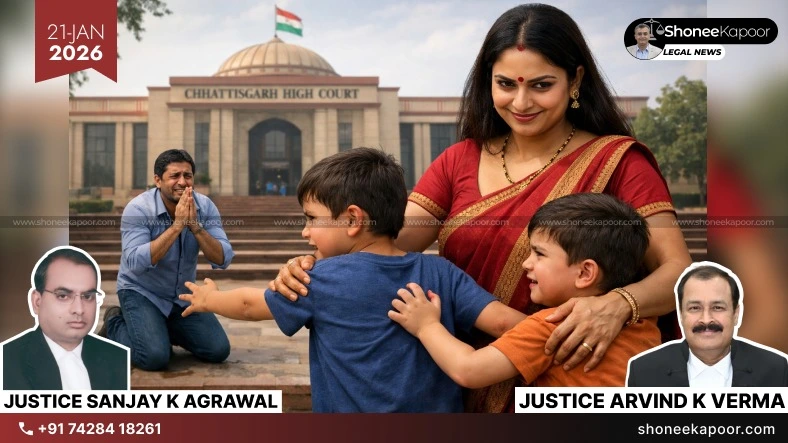
The Chhattisgarh High Court refused to give custody of a 7-year-old child to the father who was living with a second wife without divorce. The Court ruled that financial strength cannot override a child’s emotional safety and welfare with the mother.
BILASPUR: The Chhattisgarh High Court has upheld a Family Court order refusing to transfer the custody of a 7-year-old child from the biological mother to the father, after finding that the father was living with a second wife without taking a legal divorce from his first wife. The Court made it clear that in child custody matters, welfare of the child is more important than the father’s financial capacity or legal claims as a natural guardian.
The Court reiterated that child custody matters are not determined by emotional considerations, financial capacity, or parental assertions, but are guided solely by the paramount welfare of the child.
The husband and wife were married in 2013 and were blessed with two sons. Over time, matrimonial differences arose between the parties. As a result of these disputes, the wife left the matrimonial home along with the younger child, while the elder son initially remained in the custody of the father.
Later, through official intervention, the elder child was also handed over to the mother. The father, believing that law recognises him as the natural guardian, approached the Family Court under the Hindu Minority and Guardianship Act seeking custody of his son.
The Family Court rejected the father’s request. The rejection was not based on neglect, violence, or inability to care for the child. Instead, it was based on the father’s personal life. The Court found that the father was living with another woman as his second partner without legally divorcing his first wife. This was treated as misconduct and cruelty.
When the matter reached the High Court, the judges reaffirmed that child welfare dominates every custody decision. The Court observed that:
“The welfare of the minor shall be the paramount consideration.”
The Court also explained that child welfare cannot be judged by only one factor. It clearly stated that:
“Welfare of the child depends upon balancing of all the factors – physical, mental and emotional and determining what is best for the child’s total well-being.”
During the hearing, the father himself admitted that he was living with another woman as his wife without divorce. These statements remained unchallenged. The judges found that such a situation creates uncertainty for a child’s upbringing and stability.
Comparing both environments, the Court held that the child was receiving care and affection from the mother and observed that:
“It would be inappropriate to grant custody of respondent/defendant No. 2 to the appellant/plaintiff and it would be in the best interest of the minor to stay with his mother.”
The father also argued that he was financially better placed to support the child. However, the High Court firmly rejected this logic and clarified that:
“Giving sole or more importance to the superior financial capacity of the appellant/plaintiff/father would not be proper.”
This case exposes how fragile a father’s position becomes once marital disputes enter the courtroom. Even when a man is the biological parent, natural guardian, and financially stable, his personal relationships and lifestyle choices are closely scrutinised and can become the sole reason for losing access to his child.
No allegation of abuse, neglect, or danger to the child was recorded against the father. Yet, the mere presence of a second relationship without divorce was enough to defeat his custody claim. This reflects a deeper systemic imbalance where fathers face higher vulnerability and lower tolerance in custody battles.
Ultimately, the High Court dismissed the appeal and upheld the Family Court’s order, leaving both parties to bear their own costs. The judgment reinforces a difficult reality for many Indian fathers — parental rights are fragile, personal life decisions carry heavy legal consequences, and custody outcomes often place men in a legally vulnerable position despite genuine parental intent and capability.
Explanatory Table – Laws & Sections Involved
| Law / Section | What It Means in Simple Terms | How It Was Applied in This Case |
| Section 6(a), Hindu Minority and Guardianship Act, 1956 | Declares the father as the natural guardian of a minor boy. For children below 5 years, custody usually remains with the mother. | Even though the father was the natural guardian, the court held that this right is not absolute and can be overridden by child welfare. |
| Section 13(1), Hindu Minority and Guardianship Act, 1956 | Mandates that the welfare of the minor is the supreme consideration while deciding guardianship. | The Court relied on this section to prioritize the child’s emotional and moral welfare over the father’s rights. |
| Section 19(1), Family Courts Act, 1984 | Provides the right to appeal against Family Court orders before the High Court. | The father filed the present appeal under this provision after losing before the Family Court. |
| Guardians and Wards Act, 1890 (Judicial References) | Governs guardianship principles emphasizing welfare of the child rather than parental entitlement. | The Court referred to Supreme Court precedents reinforcing welfare over parental rights. |
| Order 18 Rule 4, Code of Civil Procedure (CPC) | Deals with filing of affidavits as evidence in court proceedings. | The wife’s affidavit stating the father was living with another woman remained uncontroverted. |
Case Details
- Case Title: Laxmikant Joshi vs. Lokeshwari @ Parmeshwari & Anr.
- Court: High Court of Chhattisgarh at Bilaspur
- Case Number: First Appeal (MAT) No. 87 of 2022
- Neutral Citation: 2026:CGHC:2182-DB
- Date of Judgment: 14 January 2026
- Bench: Hon’ble Shri Justice Sanjay K. Agrawal & Hon’ble Shri Justice Arvind Kumar Verma
- Counsel for Appellant: Mr. Bharat Rajput, Advocate
- Counsel for Respondents: Mr. Aman Tamboli, Advocate
Key Takeaways
- A husband’s personal relationship choices can be used to deny him child custody, even when no direct harm to the child is proven.
- Financial ability and willingness to provide are treated as secondary once allegations of moral or marital misconduct arise against the father.
- The concept of “child welfare” is often interpreted in a way that automatically favours the wife, leaving fathers on the defensive.
- Fathers are expected to meet higher standards of personal conduct, while their emotional bond with the child receives limited consideration.
- Custody disputes increasingly reflect moral judgment of men rather than an objective evaluation of parenting capability and parental equality.
This Could Change Your Case-Get FREE Legal Advice-Click Here!
Disclaimer: The views and opinions expressed in this article are those of the Indian courts and do not necessarily reflect the official policy or position of “ShoneeKapoor.com” or its affiliates. This article is intended for informational and educational purposes only. The content provided is not legal advice, and viewers should not act upon this information without seeking professional counsel. Viewer discretion is advised.