
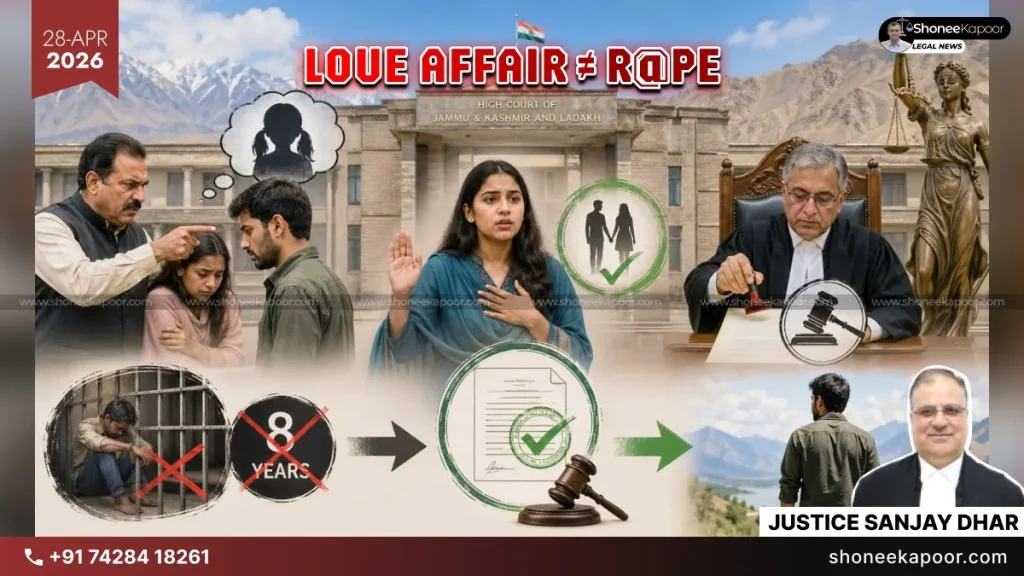
Can family resistance to a consensual relationship be used to frame a man in a rape case?
The J&K and Ladakh High Court answered No, set aside the 8-year sentence, and freed the innocent man.
SHRINAGAR: The Jammu & Kashmir and Ladakh High Court at Srinagar, through Justice Sanjay Dhar, has set aside the rape conviction of a man, holding that the case was a consensual relationship wrongly turned into a criminal prosecution.
The Court found that the prosecution failed to prove that the girl was a minor, which was the sole basis of the conviction by the trial court.
The case began when the girl’s father filed a complaint alleging kidnapping. During investigation, rape charges were added on the assumption that the girl was below 18 years of age. However, the trial court itself found that the girl had gone with the accused on her own will, and still convicted him only on the ground of alleged minority.
Before the High Court, the entire case turned on two key issues — whether the girl was actually a minor and whether the relationship was consensual. The Court closely examined the girl’s own statements and found that she had clearly admitted that she willingly accompanied the accused and had a relationship with him.
At the same time, the Court found serious defects in the prosecution’s claim regarding age. The school certificate produced had no reliable basis, and even family members could not confirm her exact date of birth. Due to this, the Court held that minority was not proved beyond reasonable doubt.
The Court also took note of the broader legal position laid down by the Supreme Court in State of Uttar Pradesh vs. Anurudh & Anr., where concerns were raised about misuse of strict laws in cases of consensual teenage relationships. Applying that principle, the High Court emphasized that courts must look at real facts and not blindly criminalize every youthful relationship.
On facts, the Court found that the prosecution itself reflected a failed relationship opposed by the girl’s family. Justice Sanjay Dhar observed:
“It seems that because of adamant attitude of the family of the prosecutrix, the love affair between the two young persons culminated in a criminal prosecution against the appellant.”
The Court made it clear that once minority is not proved, and the girl admits consent, the charge of rape cannot stand. It held:
“Thus, even if it is assumed, though not proved, that the victim was less than eighteen years of age, still then in the facts and circumstances of the case the appellant cannot be convicted of offence of rape and imprison him as the same would be unjust.”
Taking a strong stand against mechanical application of law, the Court further noted:
“Considering the closeness of age of the victim and the appellant and the fact that she had accompanied him out of her own accord because of her affection for him, putting the appellant behind the bars would be perversity of justice.”
In conclusion, the High Court held that the trial court had committed a serious legal error by relying on weak evidence of age and ignoring the consensual nature of the relationship. It finally ruled:
“The conviction recorded by the learned trial court, in the aforesaid circumstances, is not sustainable in law. The same, therefore, deserves to be set aside.”
Accordingly, the conviction and sentence were quashed, and the accused was directed to be released from custody immediately, bringing an end to a prosecution that the Court found to be unjust and legally unsustainable.
Explanatory Table: Laws And Provisions Involved
| Law / Provision | Purpose | How Applied in This Case |
| Section 376 RPC | Punishment for rape under Ranbir Penal Code (J&K law then applicable) | Accused was convicted by trial court, later acquitted by High Court |
| Section 363 RPC | Kidnapping from lawful guardianship | Trial court acquitted accused |
| Section 109 RPC | Abetment / helping in offence | FIR initially included aiding allegations |
| Section 161 Cr.P.C. | Police statement of witnesses during investigation | Prosecutrix statement recorded |
| Section 164A Cr.P.C. (as mentioned in judgment) | Statement before Magistrate / procedural recording referred in case | Prosecutrix gave statement admitting voluntary conduct |
| Section 342 J&K Cr.P.C. | Statement of accused to explain evidence against him | Accused denied allegations |
| POCSO Act | Protection of Children from Sexual Offences Act | Discussed by Court regarding misuse in consensual teenage relationships |
| Evidence Principle on Age Proof | Age must be proved by reliable evidence, not weak school entry alone | Central issue leading to acquittal |
Case Details
- Case Title: Yawar Ahmad Bhagat vs UT of J&K through P/S Yaripora
- Court Name: High Court of Jammu & Kashmir and Ladakh at Srinagar
- Case Number: CrlA(S) No. 03/2025
- Date Of Judgment: 24.04.2026
- Bench: Hon’ble Mr. Justice Sanjay Dhar
- Counsels:
- For Appellant: Mr. Zahid Hussain, Advocate with M/S Bhat Shafi, Zahid Afzal and Naveed Bukhtiyar, Advocates
- For Respondent: Mr. Zahid Qais Noor, GA
Key Takeaways
- Consensual relationships between young adults are often twisted into criminal cases due to family pressure, leading to wrongful prosecution of men.
- Mere allegation of minority is not enough — age must be strictly proved with solid evidence, otherwise the entire case collapses.
- Statements of the woman herself admitting consent are frequently ignored at trial level, causing serious miscarriage of justice.
- Criminal laws meant for protection are increasingly being misused to settle personal or emotional disputes, especially in failed relationships.
- Courts must intervene to prevent injustice, because blindly applying strict laws without examining facts can destroy an innocent man’s life.
This Could Change Your Case-Get FREE Legal Advice-Click Here!
Disclaimer: The views and opinions expressed in this article are those of the Indian courts and do not necessarily reflect the official policy or position of “ShoneeKapoor.com” or its affiliates. This article is intended for informational and educational purposes only. The content provided is not legal advice, and viewers should not act upon this information without seeking professional counsel. Viewer discretion is advised.