
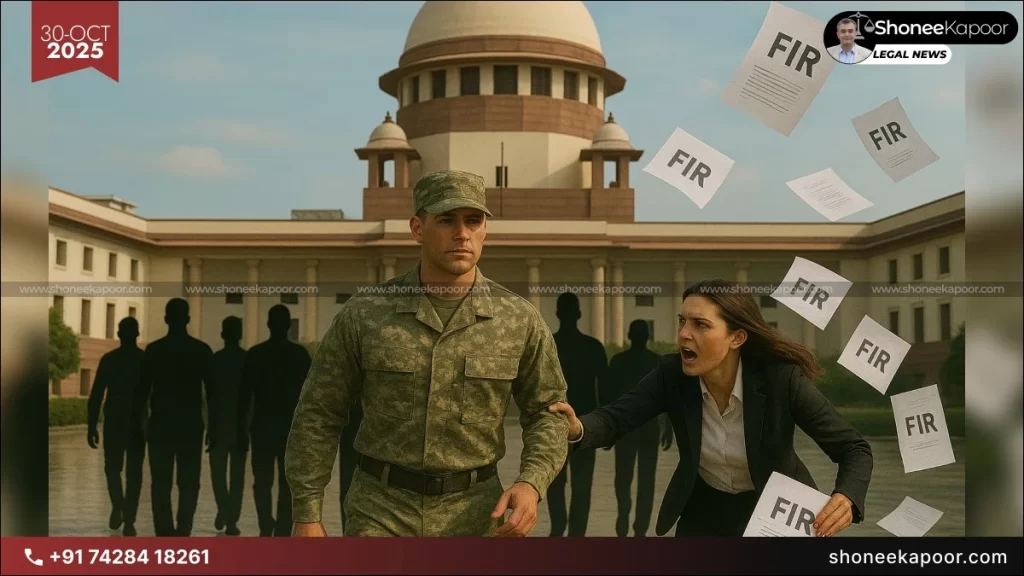
In a landmark ruling, the apex court quashed rape FIR against ex-Army officer Rakesh Walia after discovering a shocking pattern of repeated false rape allegations.
NEW DELHI: On February 25, 2025, the Supreme Court of India quashed rape FIR against Capt. (Retd.) Rakesh Walia that had been filed at the Mehrauli Police Station in South Delhi, concluding that the case was “nothing but an abuse of the process of law.” The complainant, who did not show up even after being served notice, had filed nine similar criminal cases against various men in Delhi over the years, according to the Bench of Justices Sudhanshu Dhulia and K. Vinod Chandran.
Facts of the Casea
The complainant, a 39-year-old housewife with two daughters, stated in the FIR that she had previously worked as a freelance model and that she had been living apart from her husband for three years. She claimed that Capt. Walia offered her a modelling job after they met on Facebook. She consented to meet him at the Chhatarpur Metro Station on December 29, 2021. She also added that after he gave her a cold drink that was tainted with alcohol, she passed out and was brought to an abandoned place where she was allegedly raped and molested.
Petitioner’s Defence:
Capt. Walia, a five-book author and retired Army officer, argued the charge was malicious and untrue. He clarified that no offence had been committed and that the complainant had offered to promote his books. He presented the court with a chart of previous FIRs filed by the same complainant, all of which claimed similar sexual offences against various Delhi individuals (men) and were officially recorded by the Supreme Court.
State’s Position:
Despite being duly served with notice, the complainant failed to appear or contest the proceedings before the Supreme Court. The State of NCT of Delhi, represented by Mr. Brijender Chahar, Additional Solicitor General, formally opposed the plea for quashing. However, could not dispute the record showing that the same complainant had filed eight other similar FIRs across various police stations in Delhi. In the absence of any rebuttal or supporting material from the prosecution, the Court noted that the allegations remained wholly uncorroborated, and the continuation of proceedings would serve no purpose.
Background of Procedure:
Prior to going to the Supreme Court, Capt. (Retd.) Rakesh Walia filed a motion in the Delhi High Court to revoke FIR No. 766 of 2021 filed at Mehrauli Police Station under Section 482 of the Code of Criminal Procedure, 1973 (now Section 528 of the Bhartiya Nagarik Suraksha Sanhita, 2023). However, the High Court refused to use its inherent authority and dismissed his petition. Aggrieved by that order, Capt. Walia filed Special Leave Petition which was subsequently registered as Criminal Appeal before the Supreme Court of India. The apex court granted leave, examined the entire case record, and proceeded to decide the matter on merits.
Court’s Findings
The Supreme Court Bench of Justice Sudhanshu Dhulia and Justice K. Vinod Chandran delivered a clear and unequivocal verdict, noting that the case against Capt. (Retd.) Rakesh Walia represented a textbook instance of abuse of criminal law.
After examining the FIR, the statements, and the investigation record, the Court found that no evidence existed beyond the complainant’s own statements recorded under Section 164 CrPC (now Section 183 BNSS). The Bench observed that the complainant had filed “nearly identical cases at least against eight other individuals nine cases in total”, spread across multiple police stations in Delhi. The judges described this pattern as “most concerning”, taking the appellant’s chart of prior cases on record.
The Court further recorded that the complainant had not cooperated with the investigation and had refused to appear before the Supreme Court despite service of notice.
In strong words, Justice Sudhanshu Dhulia, speaking for the Bench, observed: “Considering the nature of the case and the cumulative circumstances, we are of the opinion that the criminal case initiated against the appellant is nothing but an abuse of the process of law.”
The Bench also remarked that the Delhi High Court ought to have exercised its inherent jurisdiction under Section 482 CrPC (now Section 528 BNSS) to prevent such harassment, stating: “This is precisely the nature of case where the High Court ought to have exercised its inherent powers… and should have quashed the proceedings.”
The Supreme Court, therefore, held that continuing prosecution in these circumstances would be unjustified, and formally quashed FIR, bringing an end to four years of wrongful prosecution.
Legal Significance of this Judgement
Beyond simply dismissing a single false FIR, the Supreme Court’s ruling in Capt. (Retd.) Rakesh Walia v. State of NCT of Delhi & Anr. reaffirms the Court’s constitutional obligation to guard against the abuse of the criminal justice system. The Bench of Justice Sudhanshu Dhulia and Justice K. Vinod Chandran have made a clear distinction between protection and persecution by noting explicitly that the complainant had brought eight additional similar cases against different men, for a total of nine. The order makes it clear that the legal system cannot allow its tools to be used as harassment tools.

This ruling reinforces the body of knowledge that: False accusations are not just procedural errors; they are moral and legal injustices that destroy lives and dilute the credibility of genuine victims. The inherent powers of the courts under Section 528 BNSS (earlier 482 CrPC) are meant to safeguard citizens including men from vexatious prosecutions that serve no purpose but humiliation.
Accountability and fairness are the pillars of gender-neutral justice; compassion for victims cannot mean the abandonment of due process. This decision represents judicial recognition that innocent men should be protected when the law is twisted for retaliation or extortion, according to the men’s rights community. It restores confidence that facts and evidence, not emotion or stigma, will determine guilt and guarantees that courts will remain the last line of defence against abuse.
Explanatory Table of Laws, Cases & Sections Referenced
| Law / Case / Provision | Section / Citation | Explanation / Relevance in this Case |
| Indian Penal Code, 1860 | Sections 376, 377, 328, 506 | Offences mentioned in FIR No. 766/2021, Mehrauli Police Station, South Delhi. |
| Code of Criminal Procedure, 1973 | Section 482 | Invoked before the Delhi High Court for quashing; later replaced by Section 528 BNSS. |
| Bharatiya Nagarik Suraksha Sanhita (BNSS), 2023 | Section 528 | Modern equivalent of CrPC 482; empowers courts to quash criminal proceedings to prevent misuse of process. |
| Supreme Court Judgment | Section 183 | Corresponds to CrPC 164; used for recording complainant’s statement, the only evidence on record. |
| Doctrine of Abuse of Process | – | Applied by the Supreme Court to quash proceedings as repetitive and malicious. |
Case summary
| Field | Details |
| Case Title: | Rakesh Walia v. State of NCT of Delhi & Anr. |
| Court: | Supreme court of India |
| Bench: | Justice Sudhanshu Dhulia and Justice K. Vinod Chandran |
| Counsel: | Counsel for Petitioner: Mr. Ashwani Kumar Dubey (AOR), Mr. Adwait Ghosh, Mr. Chandra Shekhar Counsel for Respondent (State): Mr. Brijender Chahar (ASG), Mr. Mukesh Kumar Maroria (AOR), and team |
| FIR details: | FIR No. 766 of 2021- P.S. Mehrauli (South Delhi) |
| Offences involved: | Section 376, 377, 328, 506 IPC |
| Case type: | SLP (Crl.) No. 14850 of 2024 |
| Judgement date: | 25 February 2025 |
| Result: | FIR and proceedings quashed as “abuse of process of law.” |
When Justice Speaks for the Silenced: Why Everyone Must Read This Judgment
This judgment is not merely about Capt. Rakesh Walia, it’s about every man who has been silenced, shamed, or shattered by false allegations. It reminds India that truth still has a voice in its courts. When the Supreme Court called the case “an abuse of process of law,” it wasn’t just freeing one innocent officer it was reclaiming faith in justice itself.
Every citizen should read this decision to understand how easily a man’s dignity can be destroyed when the law is misused and how courage, persistence, and truth can restore it. The Rakesh Walia judgment stands as a beacon of hope, reminding society that justice is not gendered, fairness is not negotiable, and the law must protect the innocent as fiercely as it punishes the guilty.

Disclaimer: The views and opinions expressed in this article are those of the Indian courts and do not necessarily reflect the official policy or position of “ShoneeKapoor.com” or its affiliates. This article is intended for informational and educational purposes only. The content provided is not legal advice, and viewers should not act upon this information without seeking professional counsel. Viewer discretion is advise.