
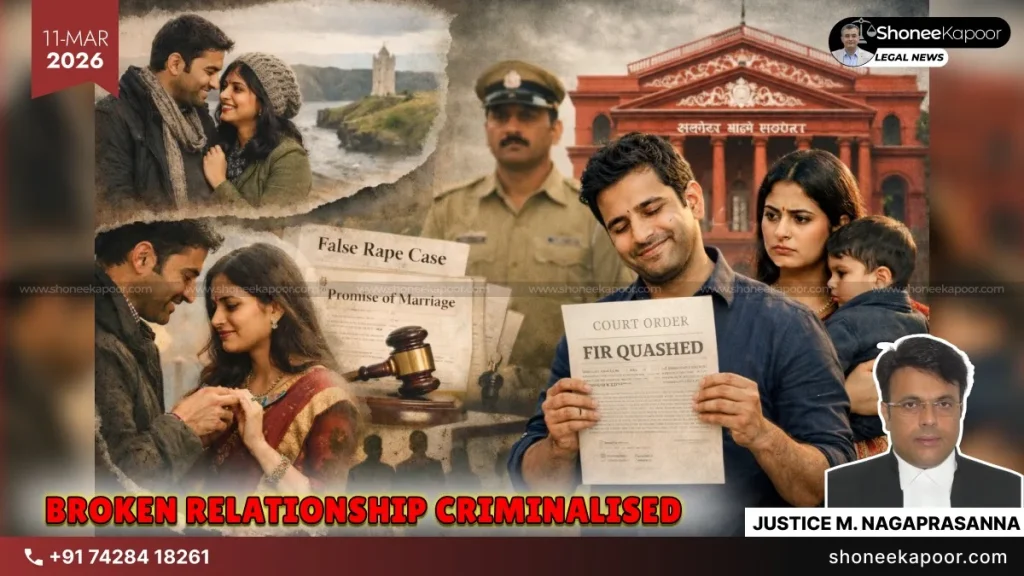
The Karnataka High Court quashed a rape case based on an alleged false promise of marriage, noting the relationship was consensual for years. It held that a breakup cannot be turned into a criminal case and warned against the misuse of criminal law.
BENGALURU: Justice M. Nagaprasanna of the Karnataka High Court quashed a criminal rape case against a man accused of having sexual relations with a woman on a false promise of marriage, holding that the dispute arose from a failed consensual relationship.
The case began after a woman filed a complaint alleging that the man established physical relations with her by promising marriage and later refused to marry her. Based on the complaint, a case was registered under Sections 69 and 115(2) of the Bharatiya Nyaya Sanhita.
The accused approached the High Court seeking the quashing of the FIR.
The Court noted that the parties met in Ireland while studying and their friendship developed into a live-in relationship. They lived together for nearly two years and had a consensual physical relationship. The relationship later broke down, after which the complaint was filed.
The Court also observed that the woman was already married and had a child when she met the petitioner, and divorce proceedings with her husband had already been initiated earlier. The Court found that the relationship between the parties was voluntary and continued for a considerable period.
Examining the complaint, the Court found no allegations of force, coercion or deception at the beginning of the relationship. Instead, the complaint itself showed companionship, cohabitation and consensual intimacy. The Court clearly observed, “the law does not criminalize heart break”.
The Court explained that a promise to marry becomes legally false only if it was dishonest from the beginning. A later refusal to marry or a relationship ending cannot automatically become a criminal offence.
The Court further remarked:
“If every broken relationship were to be clothed in the garb of criminality, the Courts would transform into forum of personal vendetta, rather than forums of justice.”
Holding that the case only reflected a relationship that eventually failed, the High Court ruled that continuing the criminal proceedings would amount to abuse of the legal process and therefore quashed the FIR.
Explanatory Table: Laws And Sections Involved
| Law / Section | Purpose | How Applied in This Case |
| Bharatiya Nyaya Sanhita, 2023 – Section 69 | Criminalizes sexual intercourse obtained through deceitful means, including false promise of marriage | The complainant alleged that the petitioner established physical relations on the promise of marriage and later refused to marry |
| Bharatiya Nyaya Sanhita, 2023 – Section 115(2) | Provides punishment related to causing hurt | This section was added in the FIR along with Section 69 in the complaint registered by police |
| Bharatiya Nagarik Suraksha Sanhita, 2023 – Section 528 | Gives inherent powers to High Courts to prevent abuse of legal process and secure justice | The petitioner approached the High Court under this provision seeking quashing of the FIR |
| Constitution of India – Article 226 | Allows High Courts to issue writs to enforce legal and fundamental rights | The writ petition challenging the FIR was filed under this Article |
| Constitution of India – Article 227 | Provides supervisory powers to High Courts over subordinate courts | Used to challenge the continuation of criminal proceedings before the trial court |
| Indian Penal Code – Section 375 (referenced in precedents) | Defines the offence of rape | Supreme Court precedents interpreting this section were relied upon to explain that consensual relationships cannot later be labelled as rape |
| Indian Penal Code – Section 376 (referenced in precedents) | Punishment for rape | Earlier Supreme Court rulings under this provision were cited to clarify the distinction between consensual relationships and false promise cases |
| Indian Penal Code – Section 90 (referenced in precedents) | Defines consent obtained under misconception of fact | Discussed by the Court while explaining that consent becomes invalid only if deception existed from the beginning |
| Criminal Procedure Code – Section 482 (referenced in precedents) | Inherent powers of High Courts to quash criminal proceedings | Judicial principles from earlier cases under this provision were relied upon for quashing the FIR |
| Supreme Court Precedent – State of Haryana v. Bhajan Lal (1992) | Landmark case laying down categories where FIR can be quashed | The Court relied on these principles to hold that continuing the investigation would be an abuse of the legal process |
Case Details
- Case Title: Harshadeep Girish Parlathaya v. State of Karnataka & Another
- Court: High Court of Karnataka at Bengaluru
- Case Number: Writ Petition No. 35036 of 2024 (GM–RES)
- Bench: Justice M. Nagaprasanna
- Dates:
- Judgment Reserved On: 24 February 2026
- Judgment Pronounced On: 04 March 2026
- Counsels:
- For Petitioner: Senior Advocate Vikram Huilgol along with Advocate Mohan Kumar G.
- For State: B.N. Jagadeesha, Additional State Public Prosecutor
- For Respondent No.2 – Parameshwarappa C., Advocate
Key Takeaways
- Consensual relationships between adults cannot be converted into criminal cases just because the relationship later breaks down. Criminal law is not meant to punish emotional failures.
- A failed promise to marry is not automatically a crime. It becomes an offence only if there was dishonest intention to deceive from the very beginning.
- Long-term live-in relationships where both adults willingly participate clearly show mutual consent, and later allegations cannot erase that consent.
- The growing trend of turning personal relationship disputes into criminal complaints is dangerous and can destroy innocent lives, careers and reputations.
- The criminal justice system must never be used as a weapon of revenge after a breakup, because misuse of such serious laws ultimately harms genuine victims and undermines justice.
This Could Change Your Case-Get FREE Legal Advice-Click Here!
Disclaimer: The views and opinions expressed in this article are those of the Indian courts and do not necessarily reflect the official policy or position of “ShoneeKapoor.com” or its affiliates. This article is intended for informational and educational purposes only. The content provided is not legal advice, and viewers should not act upon this information without seeking professional counsel. Viewer discretion is advised.