
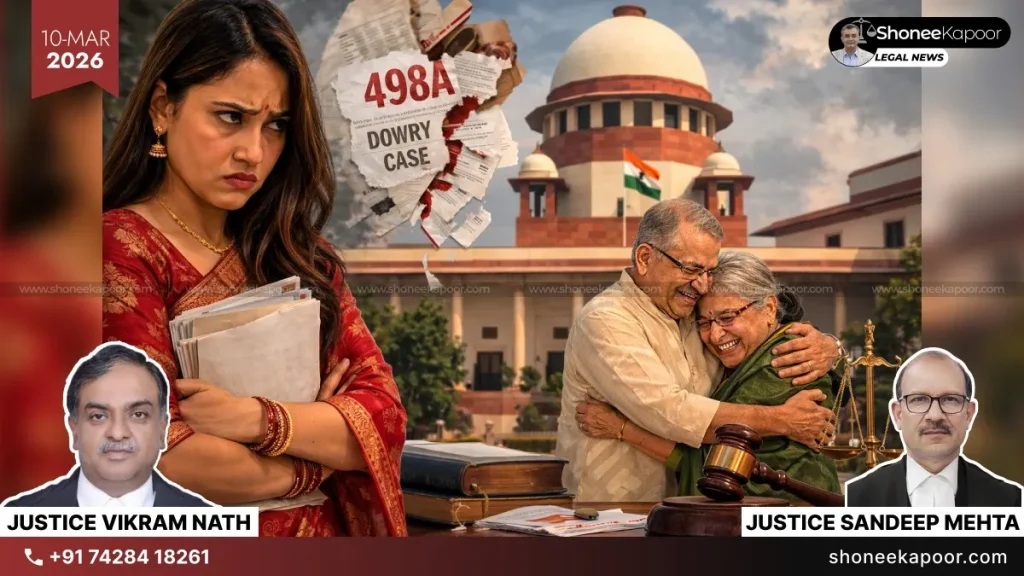
Can a family be dragged into criminal trial merely because a daughter-in-law alleges that they “quarrelled” with her? The Supreme Court has now made it clear that ordinary family disagreements cannot automatically be converted into criminal cruelty or dowry harassment.
False 498A Case: In an important relief for families facing false matrimonial cases, Justice Vikram Nath of the Supreme Court held that criminal proceedings against a husband’s parents could not be allowed to continue when the complaint did not mention any clear and separate role against them.
The Court found that the allegations were the same kind of vague and omnibus allegations which had already been rejected earlier against another family member.
The case was based on allegations of cruelty, dowry demand and assault after marriage. It was claimed that there was pressure for a BMW car and other items, and serious allegations were also made about physical violence. But when the Supreme Court examined the FIR carefully, it found that no specific date, place, individual act or clear overt role was assigned to the husband’s parents.
Justice Vikram Nath made the Court’s view very clear that:
“A comparative reading of the FIR reveals that the allegations levelled against the sister-in-law and those against the present appellants are, in all material particulars, identical. The FIR does not assign any specific or overt act to either appellant; there are no particular dates, places, or individual acts attributed to them.”
The Court further said:
“The lone allegation that stands separately against the present appellants is that they would quarrel. This, however, does not constitute a criminal offence and cannot, by itself, sustain cognizance…”
This observation is important because it shows that normal family quarrels or vague statements cannot automatically become a criminal trial under serious penal sections.
The Court also criticised the unequal approach taken earlier and said:
“The standard applied by the High Court in quashing proceedings against the sister-in-law, on the ground that the allegations against her were general and omnibus, applies with equal force to the present appellants, and there is no principled basis for distinguishing between them.”
This means the Supreme Court found that similarly placed family members cannot be treated differently when the allegations are materially the same.
Another major point noted by the Court was timing. The husband had filed for divorce in March 2021, but the criminal complaint against the parents came in March 2022, nearly a year later. On this, the Court said:
“The delay lends credence to the submission that the criminal complaint against the in-laws may have been instituted by way of a counter-blast to the divorce proceedings initiated by the husband.”
The Court then gave its final conclusion that:
“When these two considerations are read together, we are satisfied that the continuation of the criminal proceedings against the present appellants cannot be sustained.”
It also clarified that this relief was limited only to the parents and that the proceedings against the husband would continue according to law.
In the end, the Supreme Court held that the High Court had wrongly applied different standards to people standing on the same footing and quashed the criminal proceedings against the husband’s parents. The ruling is a strong reminder that in matrimonial disputes, courts must look for specific and credible allegations, and not allow elderly parents or relatives to be dragged into criminal prosecution only on the basis of general accusations.
Explanatory Table: Laws And Sections Involved
| Law / Section | Purpose | How applied in this case |
| Section 13, Hindu Marriage Act, 1955 | Divorce provision | The husband had already filed a divorce case under this section before the criminal complaint, and the Court considered this timeline important. |
| Section 341, IPC | Wrongful restraint | Included in the FIR and cognizance order against the accused family members. |
| Section 323, IPC | Causing hurt | Added on the basis of assault allegations made in the complaint. |
| Section 498A, IPC | Cruelty by husband or relatives | Main offence in the case; the Court found the allegations against the in-laws were vague and without specific acts. |
| Section 34, IPC | Common intention | Used to allege joint involvement of multiple accused persons. |
| Section 3, Dowry Prohibition Act, 1961 | Penalty for taking/giving dowry | Invoked along with dowry-related allegations in the FIR. |
| Section 4, Dowry Prohibition Act, 1961 | Penalty for demanding dowry | Applied because the complaint alleged demand for a BMW car and other items. |
| Section 482, CrPC | High Court’s quashing power | Used before the High Court to seek quashing of the criminal case. |
Case Details
- Case title: Dr. Sushil Kumar Purbey & Anr. Versus The State of Bihar and Ors.
- Court: Supreme Court of India, Criminal Appellate Jurisdiction
- Case number: Criminal Appeal No. … of 2026 arising out of SLP (Crl.) No. 3075/2024
- Bench: Justice Vikram Nath and Justice Sandeep Mehta
- Neutral citation: 2026 INSC 212
- Date of judgment: March 09, 2026
- FIR Details:
- FIR No.: 81/2022
- Police Station: Lalit Narayan University, District Darbhanga, Bihar
Key Takeaways
- Men and their families should not be pushed into criminal trials on the basis of vague, copied and family-wide allegations.
- A legal complaint must clearly show who did what, when and how; general blame against the husband’s entire family is not justice.
- Elderly parents and relatives cannot be made accused just to create pressure in a matrimonial dispute.
- When criminal law is used as a revenge tool after breakdown of marriage, it damages real justice and destroys innocent families.
- Courts must keep protecting men and their families from misuse of 498A and dowry laws through false, exaggerated and omnibus allegations.
This Could Change Your Case-Get FREE Legal Advice-Click Here!
Disclaimer: The views and opinions expressed in this article are those of the Indian courts and do not necessarily reflect the official policy or position of “ShoneeKapoor.com” or its affiliates. This article is intended for informational and educational purposes only. The content provided is not legal advice, and viewers should not act upon this information without seeking professional counsel. Viewer discretion is advised.