
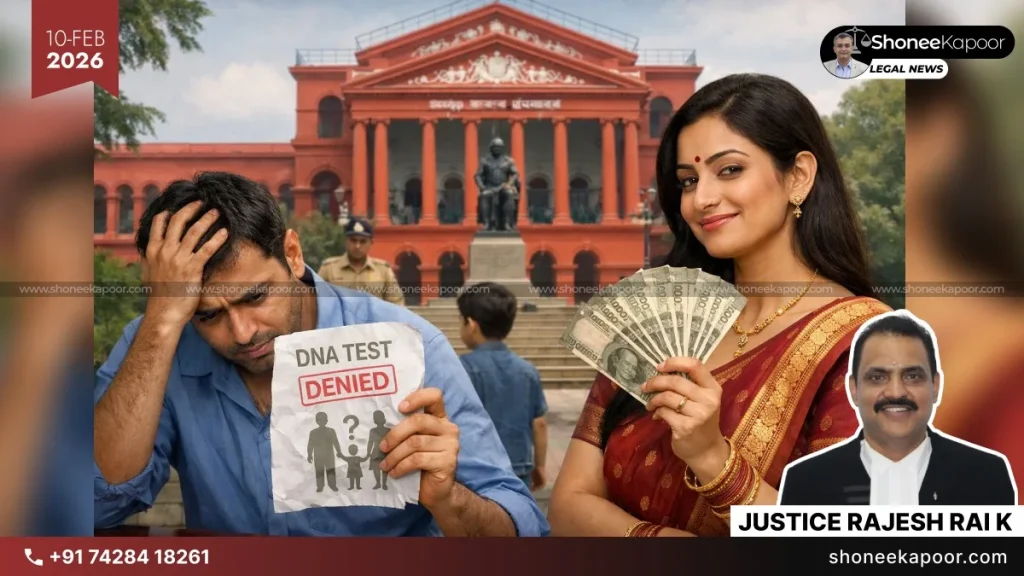
The Karnataka High Court rejected a husband’s plea for a DNA test, holding that brief and discontinuous cohabitation does not justify questioning paternity once marriage is admitted.
KALABURAGI: In a recent judgment, the Karnataka High Court, Kalaburagi Bench, presided over by Justice Rajesh Rai K, dismissed a husband’s petition seeking a DNA test of a minor child in an ongoing maintenance case.
From the husband’s side, this was an attempt to scientifically verify paternity before being compelled to bear long-term financial responsibility. However, the Court held that the request was not justified in the given facts.
The dispute arose after the marriage of the parties on 25 May 2022. A child was born thereafter. Due to marital differences, the wife approached the Family Court seeking maintenance.
During those proceedings, the husband filed an application requesting a DNA test, asserting that he had genuine doubts about being the biological father and wanted clarity through medical evidence.
The husband did not deny the marriage. He also admitted that they stayed together after marriage, but maintained that the cohabitation lasted only a few days and was not continuous. On this basis, he questioned the paternity and sought an opportunity to establish the truth through a DNA examination.
The Family Court rejected his request. It observed that since the couple had lived together and cohabited, the child’s paternity could not be doubted.
The Court also remarked that the application appeared to be filed with a preconceived notion to avoid maintenance liability.
The husband challenged this order before the High Court, arguing that a scientific test would conclusively settle the issue and prevent injustice. After hearing the matter, Justice Rajesh Rai K recorded the Court’s findings.
The Court observed:
“DNA test in a matter relating to paternity of a child should not be directed by the Court as a matter of course or in a routine manner, whenever such a request is made.”
The Judge further stated:
“The Court has to consider diverse aspects including presumption under Section 112 of the Evidence Act i.e., Section 116 of Bharatiya Sakshya Adhiniyam, 2023; pros and cons of such order and the test of ‘eminent need’ whether it is not possible for the Court to reach the truth without use of such test.”
Referring to the admitted marriage and cohabitation, the Court held
“In such circumstance, in my considered view, the paternity cannot be questioned.”
Justice Rajesh Rai K concluded:
“Hence, I am of the opinion that the Family Court has rightly passed the impugned order, which does not call for any interference.”
The petition was ultimately dismissed with the words, “Accordingly, the petition lacks merit and the same is dismissed.”
The ruling highlights the difficulty faced by men who seek scientific verification of paternity in maintenance proceedings. The Court’s decision reinforces that unless there is very strong material showing non-access, a DNA test will not be granted merely on suspicion, especially when marriage and cohabitation are admitted.
Explanatory Table: Laws And Sections Involved
| Law and Section | Purpose | How Applied in This Case |
| Section 528, Bharatiya Nagarik Suraksha Sanhita, 2023 | Grants inherent powers to High Court to prevent abuse of process and secure ends of justice | Husband invoked this provision to challenge the Family Court’s rejection of his DNA test application |
| Section 482, Code of Criminal Procedure, 1973 (Old Law) | Earlier provision conferring inherent powers on High Court | Mentioned as the corresponding old provision under which similar reliefs were earlier sought |
| Section 125, Code of Criminal Procedure, 1973 | Provides remedy for wife/child to claim maintenance | Wife initiated maintenance proceedings under this provision before the Family Court |
| Section 116, Bharatiya Sakshya Adhiniyam, 2023 | Presumption regarding legitimacy of child born during valid marriage | High Court referred to this presumption while holding that paternity cannot be questioned casually |
| Section 112, Indian Evidence Act, 1872 (Old Law) | Earlier statutory presumption of legitimacy during subsistence of marriage | Cited in the judgment while discussing the legal presumption protecting legitimacy of a child |
| Sections 39 and 116, Bharatiya Sakshya Adhiniyam, 2023 | Provisions relating to evidence and legal presumptions | Husband relied on these sections while filing application seeking DNA testing before the Family Court |
| Section 12, Family Courts Act, 1984 | Empowers Family Court regarding procedure and assistance in proceedings | Mentioned in the husband’s application filed before the Family Court |
Case Details
- Case Title: ABC Vs. XYZ
- Case No.: Criminal Petition No. 201037 of 2025
- Court: High Court of Karnataka, Kalaburagi Bench
- Neutral Citation: 2026:KHC-K:606
- Date of Judgment: 27 January 2026
- Bench: Hon’ble Mr. Justice Rajesh Rai K
- Petitioner’s Counsel: Sri Arunkumar Amargundappa, Advocate
- Impugned Order Challenged: Order dated 21.05.2025 passed on I.A. No. III in Crl. Misc. No. 227/2024 by the Principal Judge, Family Court, Raichur
Key Takeaways
- A husband’s genuine doubt about paternity is not enough; courts require strong proof before allowing a DNA test, even when lifelong financial liability is involved.
- Admission of short-term cohabitation can be treated as sufficient to reject a DNA plea, making it extremely difficult for men to seek scientific verification.
- DNA testing is not considered a routine right in maintenance cases, placing a heavy evidentiary burden on husbands.
- Legal presumptions in favour of legitimacy remain very strong, often overriding a man’s request for medical clarity.
- Men must raise and document paternity concerns at the earliest stage, as delayed doubts are viewed as attempts to evade financial responsibility.
This Could Change Your Case-Get FREE Legal Advice-Click Here!
Disclaimer: The views and opinions expressed in this article are those of the Indian courts and do not necessarily reflect the official policy or position of “ShoneeKapoor.com” or its affiliates. This article is intended for informational and educational purposes only. The content provided is not legal advice, and viewers should not act upon this information without seeking professional counsel. Viewer discretion is advised.