
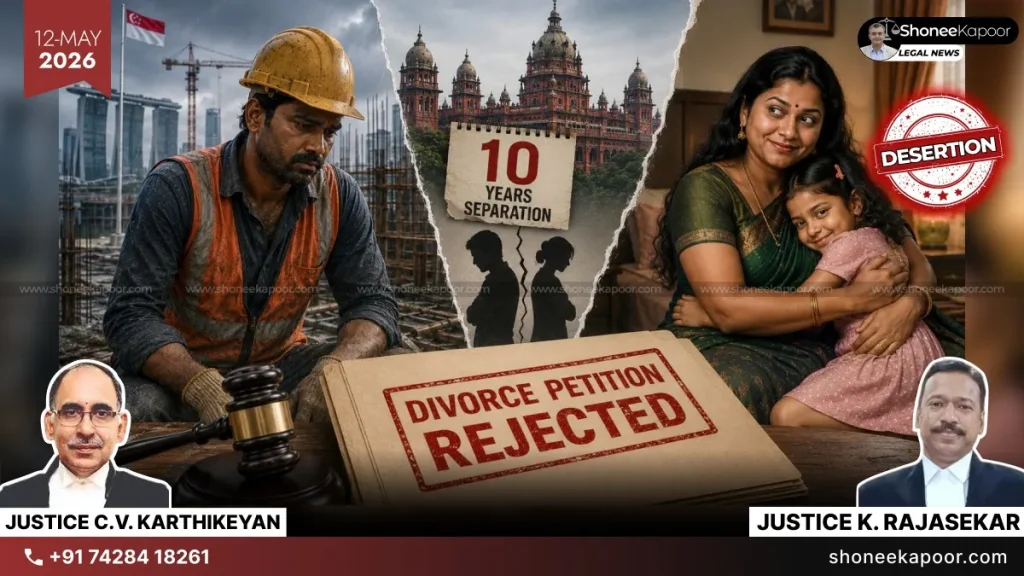
Madras High Court held that a wife staying at her parental home during pregnancy and childbirth cannot automatically be treated as deserting her husband.
How long must a husband remain trapped in a broken marriage before the law accepts irretrievable breakdown?
CHENNAI: The Madras High Court, comprising Justice C.V. Karthikeyan and Justice K. Rajasekar, dismissed a husband’s appeal seeking divorce under the Hindu Marriage Act. The husband had challenged the Family Court order which had earlier refused to dissolve the marriage between him and his wife.
The marriage took place in January 2012. According to the husband, he moved to Singapore within seven months of marriage to work as a construction labourer. He claimed he regularly sent money back home, but disputes started because the money was being sent to his mother instead of directly to his wife.
The husband alleged that his wife became upset over this issue and left the matrimonial home. He further claimed that after she became pregnant and later gave birth to their daughter in 2015, she stopped maintaining relations with him and his family. He also alleged that his family was not invited to important functions related to the child and that he was not allowed proper access to his daughter.
The husband argued that the couple had been living separately for nearly 10 years and that the marriage had completely broken down. He also told the Court that he suffered from medical problems and had lost stable employment.
However, the wife denied the allegations and stated that she was forced to stay with her parents during pregnancy because she did not receive proper care or financial support from the husband. She also said she had to file a maintenance case because the husband failed to maintain her and the child.
While refusing divorce, the High Court observed that the husband himself had failed to properly recognise and support his wife after marriage. The Court noted:
“The appellant should have recognised her status as a wife and should have atleast forwarded a portion of the surplus amount to her rather than sending the entire amount to his mother.”
The Bench further said:
“Having failed to do so, the appellant cannot hide his own fault and put the blame on the respondent.”
On the issue of desertion, the Court made it clear that a woman staying at her parental home during pregnancy and childbirth cannot automatically be treated as abandoning the marriage. The judges observed:
“She had to necessarily go to her mother’s house for the birth of the child… That cannot be stated to be an act of desertion.”
The husband had also accused the wife of being in contact with another man. However, the Court found that no evidence was produced to support the allegation. Criticising the accusation, the Court observed:
“This false allegation would have naturally affected the respondent herein.”
The High Court finally held that ordinary matrimonial disputes and isolated incidents cannot become grounds for divorce. The Bench observed:
“Stray incident cannot be a ground of dissolution of marriage. They are only scratches in the marital life.”
With these observations, the Madras High Court dismissed the husband’s appeal and upheld the Family Court order refusing divorce.
Explanatory Table: Laws And Provisions Involved
| Law / Section | Purpose | How Applied In This Case |
| Section 13(1)(i-a), Hindu Marriage Act, 1955 | Allows divorce on the ground of cruelty by spouse | Husband claimed wife mentally harassed him and treated him cruelly |
| Section 13(1)(i-b), Hindu Marriage Act, 1955 | Allows divorce if one spouse deserts the other continuously for at least 2 years | Husband alleged wife deserted him by staying at her parents’ house |
| Section 19, Family Courts Act, 1984 | Gives right to file appeal against Family Court judgment before High Court | Husband used this provision to challenge Family Court’s refusal of divorce |
| Maintenance Proceedings (M.C. No. 6 of 2020) | Legal proceeding where wife seeks financial support from husband | Court noted wife filed maintenance case because husband allegedly failed to support wife and child financially |
| Restitution of Conjugal Rights | Legal remedy seeking direction for spouse to resume cohabitation | Husband argued wife never filed such a petition to return to matrimonial life |
Case Details
- Case Title: P v. S
- Case Number: CMA No. 706 of 2023
- Court: Madras High Court
- Date of Judgment: 28 April 2026
- Bench: Justice C.V. Karthikeyan | Justice K. Rajasekar
- Counsels:
- For Appellant: Mr. K. Ravi Anantha Padmanaban for Mr. B. Thirumalai
- For Respondent: Mr. T. Balaji Thirumoorthy
Key Takeaways
- Long separation alone is often not enough for a man to get divorce, even when the marriage has practically ended years ago.
- Financial disputes inside marriage can later be interpreted against husbands, especially when money is sent to parents instead of wife.
- Unproven allegations against wife can heavily damage the husband’s case and may itself be treated as wrongful conduct.
- Men working abroad or away from home still carry continuing legal and financial responsibilities towards wife and child.
- Matrimonial litigation increasingly examines the husband’s conduct in detail, while emotional breakdown of marriage alone may not receive equal importance.
This Could Change Your Case-Get FREE Legal Advice-Click Here!
Disclaimer: The views and opinions expressed in this article are those of the Indian courts and do not necessarily reflect the official policy or position of “ShoneeKapoor.com” or its affiliates. This article is intended for informational and educational purposes only. The content provided is not legal advice, and viewers should not act upon this information without seeking professional counsel. Viewer discretion is advised.