
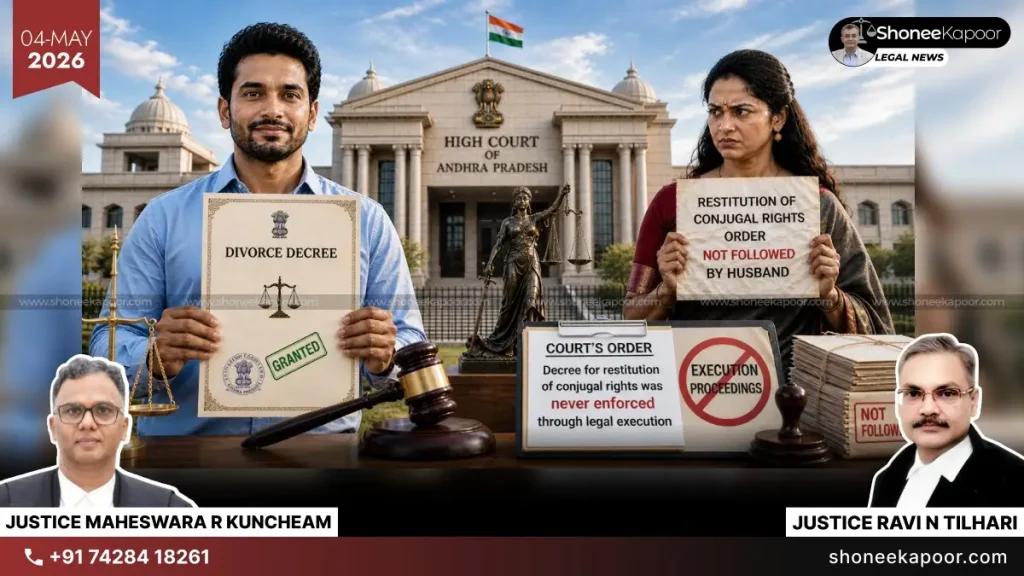
Does failure to live together after a restitution of conjugal rights order automatically make the husband guilty?
The Andhra Pradesh High Court answers No, holding that the law requires clear proof of wrongful conduct, not just non-resumption of cohabitation.
AMARAVATI: In a recent judgment, the High Court of Andhra Pradesh, led by Justice Ravi Nath Tilhari and Justice Maheswara Rao Kuncheam, allowed a husband’s appeal and granted divorce, setting aside the Family Court’s earlier refusal.
The case concerned a marriage from 1992, where the couple had been living separately for a long time. Earlier, a decree for restitution of conjugal rights was passed, legally requiring the parties to resume cohabitation.
However, even after more than one year of the decree, there was no reunion, following which the husband approached the court seeking divorce under Section 13(1A)(ii) of the Hindu Marriage Act.
The Court examined the defence that efforts were made to resume the marriage but found the supporting evidence unreliable and inconsistent. The judges observed that the testimonies did not establish any clear fault on the part of the husband and failed to discharge the burden of proof required in such cases.
Clarifying the legal position, the Court emphasized that mere reluctance or failure to take back a spouse does not amount to “wrong” under Section 23 of the Hindu Marriage Act. It clearly held:
“The conduct alleged has to be something more than a mere disinclination to agree to an offer of reunion.”
The Court further reinforced that:
“Any ‘wrong’ within the meaning of Section 23 (1)(a) of the Hindu Marriage Act on the part of the husband could not be established or proved.”
The judges also highlighted that the decree for restitution of conjugal rights was never enforced through legal execution, which weakened the claim that there was a genuine attempt to resume matrimonial life. The Court noted that:
“There is nothing on record to indicate… that the decree for restitution of conjugal rights was put for execution.”
After evaluating both facts and law, the Court concluded that the statutory requirement of one year of non-compliance was fulfilled and the husband was not taking advantage of his own wrong. It further held that “the ground for divorce under Section 13 (1-A) of the Hindu Marriage Act was made out” and the Family Court had erred in appreciating both evidence and legal principles.
Accordingly, the High Court allowed the appeal and dissolved the marriage, bringing an end to a long-pending matrimonial dispute.
Explanatory Table: Laws & Sections Involved
| Law / Section | Provision | Simple Explanation |
| Hindu Marriage Act, 1955 – Section 13(1A)(ii) | Divorce after non-compliance of restitution decree for 1 year | If spouses don’t resume living together for 1 year after court order, either can seek divorce |
| Hindu Marriage Act, 1955 – Section 23(1)(a) | No advantage of own wrong | Court must ensure the person asking for relief is not benefiting from their own misconduct |
| Hindu Marriage Act, 1955 – Section 9 | Restitution of conjugal rights | Court can order spouse to resume cohabitation |
| Code of Civil Procedure – Order 21 Rule 31 | Execution of restitution decree | If spouse does not obey court order, enforcement can be done through attachment of property |
Case Details
- Case Title: T. Ravi vs T. Lakshmi Devi
- Case Number: Civil Miscellaneous Appeal No. 4279 of 2004
- Court: High Court of Andhra Pradesh
- Date of Judgment: 28.04.2026
- Bench: Justice Ravi Nath Tilhari | Justice Maheswara Rao Kuncheam
- Counsels:
- For Appellant: Sri K. A. Narasimham
- For Respondent: Sri Anup Koushik Karavadi
Key Takeaways
- A husband cannot be denied divorce merely on vague allegations; strict proof of “wrong” is required under Section 23 HMA.
- Mere refusal or delay to take the wife back is not misconduct; law requires serious wrongdoing, not emotional narratives.
- After one year of non-compliance of restitution decree, divorce becomes a clear statutory right under Section 13(1A)(ii).
- Burden lies on the wife to prove husband blocked reunion; failure to produce credible evidence collapses the defence.
- Misuse of restitution orders to trap men into endless litigation is curtailed; courts are recognising ground reality over sympathy-based decisions.
This Could Change Your Case-Get FREE Legal Advice-Click Here!
Disclaimer: The views and opinions expressed in this article are those of the Indian courts and do not necessarily reflect the official policy or position of “ShoneeKapoor.com” or its affiliates. This article is intended for informational and educational purposes only. The content provided is not legal advice, and viewers should not act upon this information without seeking professional counsel. Viewer discretion is advised.