
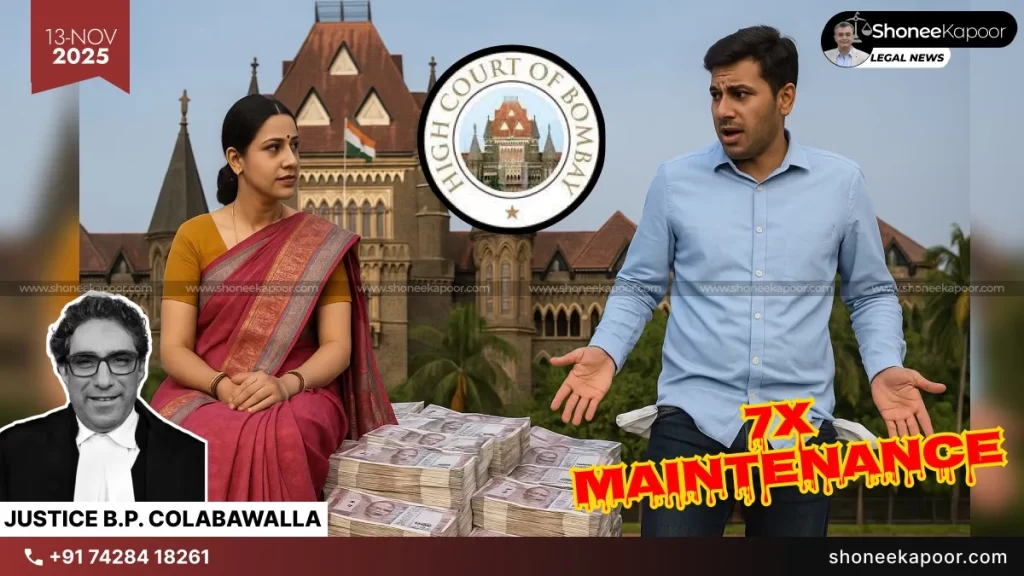
The Bombay High Court raised monthly maintenance for a divorced wife from ₹50,000 to ₹3.5 lakh after finding the husband concealed his true income and came from a business group worth over ₹1,000 crore. The husband was also ordered to pay ₹42 lakh as arrears within four weeks.
Raises Wife Maintenance: The Bombay High Court has sharply increased the maintenance payable by a Pune-based businessman to his divorced wife, after finding that he had deliberately hidden his real financial capacity and misled the court.
The Bench of Justices B.P. Colabawalla and Somasekhar Sundaresan found that the husband’s claim of earning only ₹6 lakh per year was “farcical” given his family’s extensive business interests and property holdings running into over ₹1,000 crore.
Originally, the Family Court in Pune had granted divorce in February 2023 after the couple — married in 1997 and separated in 2013 — had lived together for 16 years. The court awarded the wife permanent alimony of ₹50,000 per month.
Both the husband and wife appealed: the wife sought a higher maintenance, while the husband argued he had no means to pay.
During the appeals, the wife argued that she was struggling to support their daughter alone, and described the husband as a “chronic defaulter” who continued an extravagant lifestyle. The husband claimed that his income had fallen after COVID and that he had “already paid enough”, also pointing to a ₹50 lakh loan given to the wife’s uncle as effectively settling his maintenance obligations.
The High Court rejected these claims. It held that the husband’s portrayal of financial distress was entirely implausible in light of the evidence. According to the Bench, his family group engaged in multiple real‐estate, construction and financial‐services businesses whose aggregate worth exceeded ₹1,000 crore.
The husband was publicly described as the “torchbearer” of the business group on its website — a fact clearly at odds with his income tax returns showing an annual income of merely ₹6 lakh.
As Justice Sundaresan observed:
“By pointing to his Income Tax Returns to show taxable income of just ₹6 lakh annually, he would have the Court believe that his lifestyle is financed by ₹50,000 per month. On the face of it, the import is farcical.”
The Court found that his income-tax filings and property declarations did not reflect the true picture of his wealth. Significant transfers of funds to his brother’s accounts, delayed filings of financial statements by companies under his control, and lavish personal expenditure including foreign holidays and luxury brand purchases all pointed to substantial means.
“A blinkered focus on the seemingly de jure position by looking only at such assets as the family has chosen to officially leave in the hands of the husband’s Income Tax balance sheet, or just the component of the family income that the family has chosen to attribute to such family member, would be quite inappropriate, misleading and unjust.” -the Bench observed.
For example, the judgment cited photographs of a birthday party at which there was “free-flowing alcohol” and guests wearing high-end Kenzo T-shirts; the husband’s foreign holidays (including to Macau) and his son’s overseas education were held to demonstrate that he lived far beyond the income he claimed.
The Court added:
“We must hasten to add that to our minds, there is nothing to be judgemental or inappropriate about throwing a milestone birthday party with free-flowing alcohol, or the donning of expensive top of the line luxury brand T-shirts at the party. What does not appeal to us in forming our judgement, is the act of contemporaneously lying on oath about being a man of no means, earning just Rs. 6 lakhs per annum.”
The Court held that the Family Court had failed to properly appreciate the true financial strength of the husband and his group. It observed that a woman in a divorce proceeding is entitled to maintain a dignified life and provide her daughter with dignity.
The Bench stated:
“She is entitled to lead a life of dignity and provide her daughter a life of dignity. A sum of ₹50,000 per month is hardly a reasonable or logical quantum of maintenance.”
The Bench further criticised the husband’s argument that the separated wife should reduce her daughter’s extracurricular expenses such as yoga, violin and baking classes.
The Court termed this argument patriarchal, elaborating:
“The contention is that a woman divorced from her husband should curtail what her daughter should get but a woman choosing not to leave her husband can expect more. That a mother dares to work hard and even claim to depend on her own brother to give the daughter (who is as much Mukesh’s offspring) a decent life, cannot be a disqualification for expecting that the daughter’s expenses for a decent standard of living be met by the father, commensurate with his own standard of living and more importantly, the parents’ joint standard of living when the marriage had lasted.”
After weighing all the factors, the Bombay High Court raised the monthly maintenance payable by the husband to his divorced wife from ₹50,000 to ₹3.5 lakh. It also ordered the husband to pay arrears of ₹42 lakh for one year within four weeks.
In this order, the Court sought to send a clear message: a spouse cannot hide behind minimal declared income while enjoying a lavish lifestyle, and maintenance obligations must reflect true means, not paper filings alone.
For men’s-rights and fairness in family-law contexts, the judgment is significant — it underscores that the legal notion of maintenance is not only about formal income as declared to the tax department, but also about the real financial capacity and lifestyle enjoyed by the parties.
For practitioners drafting petitions or advising clients, the case emphasises the need for full disclosure of financial records, monitoring transfers and corporate relationships, and being alert to “fanciful” claims of poverty when the family business shows otherwise.

Explanatory Table – Laws & Principles Applied
| Law / Concept | Legal Provision / Principle | Explanation in Context |
| Hindu Marriage Act, 1955 – Section 25 | Permanent alimony and maintenance | Allows either spouse to seek maintenance after divorce based on income, property, and standard of living. The Court invoked this section to raise the wife’s maintenance. |
| Doctrine of Clean Hands | Equity principle: one must approach court honestly | The husband concealed assets and misled the court; the Bench said he didn’t come with “clean hands”. |
| Standard of Living Test | Derived from maintenance jurisprudence (Section 24 & 25 HMA) | Maintenance must allow the dependent spouse to live at a standard comparable to that enjoyed during marriage. |
| Misrepresentation and Suppression of Facts | Civil procedure principle (under Section 151 CPC inherent powers) | When a party misstates financial data, the court can disregard formal records and rely on surrounding lifestyle evidence. |
| Right to Dignified Life | Article 21 of the Constitution of India | The Court emphasized that the wife and daughter must live with dignity consistent with the father’s financial capacity. |
| Patriarchal Mindset Critique | Judicial observation | The Bench condemned the idea that a divorced woman or her child should compromise their lifestyle because the marriage ended. |
Case Summary
| Particular | Details |
| Case Title | Pune Businessman v. Ex-Wife |
| Court | Bombay High Court |
| Bench | Justice B.P. Colabawalla and Justice Somasekhar Sundaresan |
| Date of Judgment | November 2025 (recent ruling) |
| Counsel for Husband | Advocates Dushyant Purekar and Rajat Dedhia |
| Counsel for Wife | Appeared in person |
| Marriage Duration | Married in 1997 — separated in 2013 after 16 years |
| Family Court Order (2023) | Divorce granted on cruelty; ₹50,000/month maintenance |
| High Court Decision | Maintenance enhanced to ₹3.5 lakh/month + ₹42 lakh arrears to be paid within 4 weeks |
| Main Finding | Husband hid true income and assets worth over ₹1,000 crore; declared income ₹6 lakh/year was false |
| Lifestyle Evidence | Lavish parties, foreign holidays, luxury brands, ₹10 crore transfers to brother’s account |
| Court Observation | Concealment of income and false affidavit amount to misleading the court |
| Outcome | Wife entitled to live with dignity and provide the same standard of living to her daughter |
Key Takeaways
- Selective Sympathy: Courts still assume men are hiding income — even when there’s no proven direct ownership of assets. “Family wealth” is now being used to inflate maintenance, blurring personal liability.
- Standard of Living Bias: The judgment equates the wife’s right to the same standard of living during marriage, but ignores that post-divorce, both parties’ finances and responsibilities change drastically.
- Punished for Family Success: The man was held responsible for the entire family group’s worth, not just his declared earnings — a dangerous precedent where family prosperity becomes a weapon against one member.
- Lifestyle Policing: Courts using photos of clothes, parties, and holidays as evidence of hidden wealth is intrusive — and sets a trend of judging men’s private lives, not just their income proofs.
- No Relief for Male Hardship: While the wife’s struggles are recognized, the man’s post-divorce financial burdens, loans, and liabilities find no empathy. Courts rarely ask how much he must earn to sustain both lives.
- Maintenance Inflation: ₹50,000 to ₹3.5 lakh — a sevenfold hike — sends a message that “lavish living” can override documented financial disclosures. Men are judged by perception, not paper.
- Gender-Neutral Need Ignored: True equality would mean a neutral inquiry into both spouses’ earning capacities — not automatic assumption that the man must pay more, regardless of evidence.

Disclaimer: The views and opinions expressed in this article are those of the Indian courts and do not necessarily reflect the official policy or position of “ShoneeKapoor.com” or its affiliates. This article is intended for informational and educational purposes only. The content provided is not legal advice, and viewers should not act upon this information without seeking professional counsel. Viewer discretion is advised.