
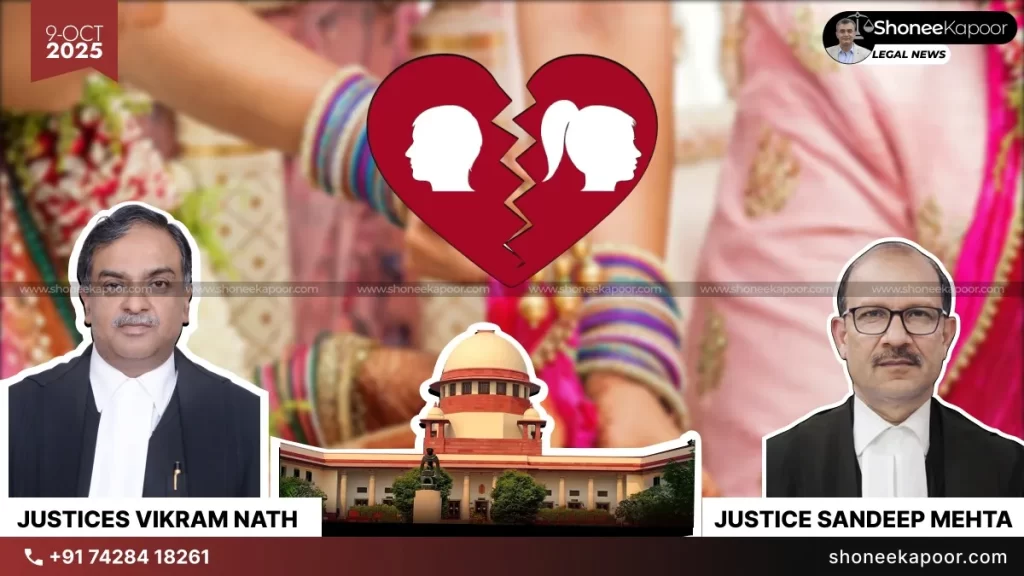
The Supreme Court of India has voiced serious concern over the rising number of divorce and bail petitions reaching the apex court, warning that it is turning into a “matrimonial and bail court.” The judges highlighted how repeated adjournments in lower courts are burdening the top court unnecessarily.
NEW DELHI: The Supreme Court of India recently raised strong concerns about the increasing number of divorce cases and bail matters being filed directly before it from across the country.
A bench of Justices Vikram Nath and Sandeep Mehta noted that the top court was now functioning more like a matrimonial and bail court rather than focusing on major constitutional and legal issues.
The observation came when the bench was hearing a case related to repeated adjournments in matrimonial proceedings before the Rajasthan High Court.
While addressing the matter, the bench remarked,
“If we start entertaining these matters for being adjourned, this Court would be flooded with divorce petitions from all over the country…all divorce matters will come before this Court. As it is, we are more of a matrimonial and bail court now. Soon, it will become totally matrimonial.”
The petitioner had approached the Supreme Court, claiming that the Rajasthan High Court had not heard his case despite it being listed several times. He requested the Supreme Court to intervene and issue directions for mediation so that both parties could try for a settlement.
Justice Nath further pointed out,
“If we start entertaining these matters for being adjourned….this Court would be flooded with divorce petitions from all over the country.”
After some discussion, the counsel representing the petitioner decided to withdraw the plea, seeking permission to approach the Rajasthan High Court again for an early hearing instead.
Interestingly, this is not the first time such a concern has been raised by the Supreme Court. Earlier, Justice BV Nagarathna had also expressed similar frustration over the growing number of bail cases reaching the Supreme Court. She noted that the Court was gradually becoming a “bail court.”
As her bench was about to take a lunch break on a non-miscellaneous day, Justice Nagarathna humorously but seriously remarked,
“Can’t continue like that without lunch because we are exhausting ourselves only granting bail.”
Justice Nagarathna also highlighted that if lower courts strictly followed the directions and orders of the Supreme Court, many such bail cases would not reach the top court at all. She explained that during her tenure in the High Court, she never dealt with bail cases and had to learn the work only after joining the Supreme Court.
She observed,
“By the time the matter comes here, time has also lapsed, the man is inside for a sufficient long time, the charge sheet would have been filed, investigation is over, charges would have been framed, the trial would have commenced, so accordingly we consider the case. But the thing is we are becoming a bail court. I never sat in the High Court for bail, at all. I had to learn the work after coming here.”
Meanwhile, the Supreme Court has also directed all High Courts in India to take serious action to ensure day-to-day hearings in sensitive or important criminal cases. The aim is to reduce long delays in justice and make the trial process more efficient.
A bench of Justices J.B. Pardiwala and K.V. Viswanathan recently observed that non-continuous criminal trials, where witnesses and evidence are heard in small parts over months or even years, have become a major reason for delay in delivering justice.

The bench strongly underlined that the right to a speedy trial is a vital part of the right to life under Article 21 of the Indian Constitution. They stressed that continuous hearings and timely verdicts are necessary to maintain people’s trust in the judicial system.
Explanatory Table: Laws / Sections Relating to Matrimonial & Bail Proceedings
| Law / Provision | What It Is / Purpose | Relevance in Context |
|---|---|---|
| Hindu Marriage Act, 1955 | A law governing marriage, divorce, judicial separation, etc., among Hindus | Many divorce petitions in India proceed under this Act (or equivalent personal law), so Supreme Court’s concern relates to being overburdened with such matrimonial cases |
| Special Marriage Act, 1954 | Allows civil (non-religious) marriages and processes for divorce, etc. | Some matrimonial disputes fall under this for couples married under secular law |
| Code of Criminal Procedure, 1973 (CrPC) | The procedural law for criminal trials, bail, etc. | Bail matters and trial scheduling derive from CrPC rules (e.g. sections dealing with grant of bail, hearing of charges, continuous trial) |
| Indian Constitution – Article 21 | Guarantees the right to life and personal liberty, includes right to speedy trial | Bench noted that right to speedy trial is integral to Article 21 and delays or fragmented trials violate this right |
| Constitution – Article 32 / Article 136 | Article 32 (right to constitutional remedies), Article 136 (special leave to appeal to SC) | Supreme Court’s jurisdiction to hear appeals or special leave petitions is based on these constitutional provisions, which underlie why divorces or bail matters may be brought to it |
Case Summary
- Bench: Justices Vikram Nath & Sandeep Mehta
- Counsel / Parties: The petitioner (an Army officer in the reported matter) and his counsel; also respondent (the opposing spouse / party in High Court proceedings)
- Subject / Issue: Repeated adjournments in matrimonial case in Rajasthan High Court; request for Supreme Court intervention and mediation direction; concern about Supreme Court being burdened with divorce petitions and bail matters
- Outcome / Order: The counsel for petitioner sought permission to withdraw the plea, with liberty to approach Rajasthan High Court for early hearing.
- Other Related Directions: Supreme Court also directed High Courts to form committees for ensuring day-to-day trials in important criminal cases. Bench of Justices J.B. Pardiwala & K.V. Viswanathan emphasized continuous trials to uphold the right to speedy trial under Article 21.

Disclaimer: The views and opinions expressed in this article are those of the Indian courts and do not necessarily reflect the official policy or position of “ShoneeKapoor.com” or its affiliates. This article is intended for informational and educational purposes only. The content provided is not legal advice, and viewers should not act upon this information without seeking professional counsel. Viewer discretion is advised.