
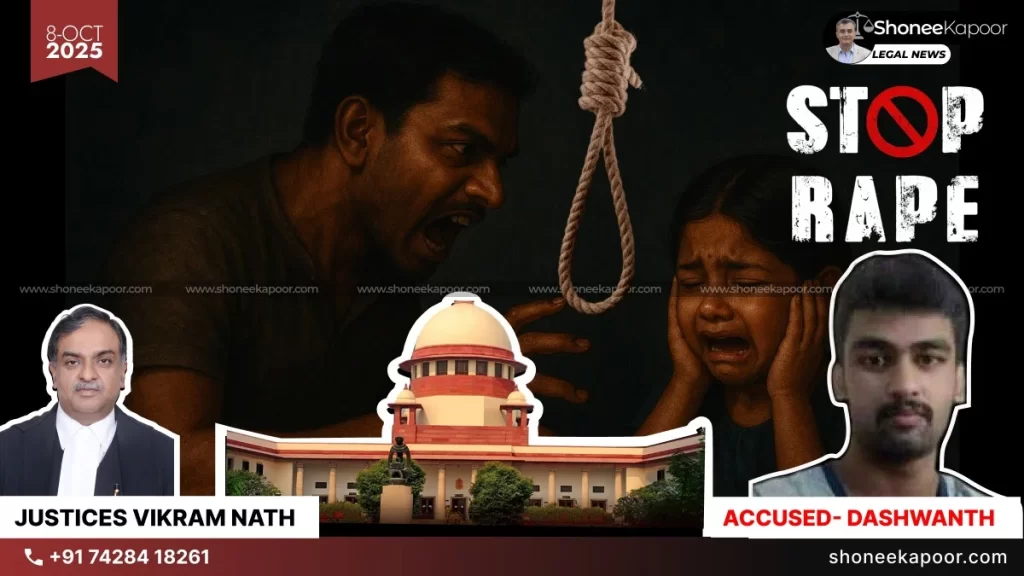
The Supreme Court Today (Oct 8) overturned the conviction and death penalty of Dashwanth, accused in the 2017 rape and murder of a 7-year-old girl in Chennai. The Court said the prosecution “miserably failed to prove the vital circumstances,” ordering his immediate release.
NEW DELHI: In a major judgment, the Supreme Court of India today set aside the conviction and death sentence of Dashwanth, who was accused of raping and murdering a 7-year-old girl in Mugalivakkam, Chennai, in 2017. The top court ordered his immediate release, stating that the prosecution had “miserably failed to prove the vital circumstances.”
The case had drawn national attention eight years ago when the minor went missing from her apartment building and was later found dead. But after years of legal proceedings, the Supreme Court has now acquitted the accused citing lack of conclusive evidence.
The three-judge Bench of Justices Vikram Nath, Sanjay Karol, and Sandeep Mehta delivered the verdict, allowing the appeal filed by Dashwanth against his earlier conviction and sentence.
Quoting from the detailed judgment, the Bench observed:
“We are of the view that the prosecution has miserably failed to prove the vital circumstances, that is, last seen together, suspicious […] of the appellant captured in the video footage of the CCTV camera, the confessional disclosure statement, the FSL report […] which constituted the entire edifice of the prosecution case on which the conviction of the appellant was based. The impugned judgment is set aside. The appeal is allowed. The conviction and sentence awarded to the appellant are hereby set aside. Appellant is acquitted. He shall be released from custody forthwith, if not wanted in any other case.”
The Supreme Court thus made it clear that the evidence presented by the prosecution did not establish a strong chain of circumstances necessary to convict the accused in such a serious offence.
The Court also noted that since all vital elements like CCTV footage, confessional statements, and forensic reports were either weak or inconsistent, the benefit of doubt must go to the accused.
Dashwanth had challenged the 2018 Madras High Court judgment, which had upheld his conviction and confirmed the death sentence handed down by the trial court.
The prosecution’s case claimed that the 7-year-old victim went missing at 6 PM on February 5, 2017, from her residential building. After a massive search operation by her parents and the police, her burnt body was discovered at dawn on February 8, 2017. Investigators had alleged that Dashwanth was involved and arrested him the same day.

In 2019, the Supreme Court had issued a limited notice focusing only on the aspect of the death sentence. Later, the defence moved a petition to extend the notice to include the question of conviction itself, which the Court eventually agreed to examine.
After reviewing all evidence, the apex court concluded that the entire case built by the prosecution lacked credible proof, and therefore, the conviction could not be sustained.
Explanatory Table: Laws and Sections Involved in the Dashwanth Case
| Law / Code | Section / Provision | Subject / Title | Explanation (in Simple Terms) | Relevance in This Case |
| Indian Penal Code (IPC), 1860 | Section 302 | Punishment for Murder | Whoever commits murder shall be punished with death or imprisonment for life, and shall also be liable to fine. | Dashwanth was convicted under this section by the Trial Court and sentenced to death for allegedly murdering the 7-year-old girl. |
| Indian Penal Code (IPC), 1860 | Section 376(2) | Rape of a Minor (Aggravated Penetrative Sexual Assault) | Covers rape involving minors or cases where the victim is below 12 years of age, with harsher punishment including death penalty in extreme cases. | The prosecution alleged that Dashwanth had raped the 7-year-old girl before murdering her. |
| Indian Penal Code (IPC), 1860 | Section 201 | Causing Disappearance of Evidence of Offence, or Giving False Information | Punishes any act of destroying evidence or misleading investigation after committing an offence. | The prosecution alleged that the accused burnt the victim’s body to destroy evidence. |
| Code of Criminal Procedure (CrPC), 1973 | Section 313 | Power to Examine the Accused | Allows the court to question the accused personally to explain any circumstances appearing in the evidence against them. | Dashwanth was examined by the Trial Court under this section, but the Supreme Court found the overall evidence insufficient. |
| Code of Criminal Procedure (CrPC), 1973 | Section 235(2) | Hearing on Sentence | After conviction, the court must hear the accused on the question of sentence before deciding punishment. | The Trial Court, after hearing, imposed the death penalty under this section. |
| Indian Evidence Act, 1872 | Section 27 | Discovery of Facts Based on Confession to Police | States that only that part of a confession which leads to discovery of a fact can be used as evidence. | The prosecution relied on the accused’s alleged disclosure statement; however, the Supreme Court said it was unreliable. |
| Indian Evidence Act, 1872 | Section 65B | Admissibility of Electronic Evidence (like CCTV Footage) | Defines the conditions under which electronic records such as CCTV footage are admissible in court. | CCTV footage was part of the prosecution’s case, but the Supreme Court said the footage did not conclusively identify the accused. |
| Constitution of India | Article 21 | Right to Life and Personal Liberty | Guarantees that no person shall be deprived of life or liberty except according to procedure established by law. | The Supreme Court’s acquittal upholds the principle that no one can be punished without conclusive proof beyond reasonable doubt. |
| Supreme Court’s Criminal Appellate Jurisdiction | Article 136 of the Constitution | Special Leave to Appeal | Allows the Supreme Court to hear appeals against any judgment or order from any court in India. | Dashwanth appealed to the Supreme Court under this provision after the Madras High Court confirmed his death sentence. |
Complete Case Summary: Dashwanth v. State of Tamil Nadu
- Case Title: Dashwanth v. The State of Tamil Nadu
- Citation / Case Number: Criminal Appeal Nos. 3633–3634 of 2024
- Court: Supreme Court of India
- Jurisdiction: Criminal Appellate Jurisdiction
- Bench / Judges: Hon’ble Mr. Justice Vikram Nath, Hon’ble Mr. Justice Sanjay Karol, and Hon’ble Mr. Justice Sandeep Mehta
- Date of Judgment: 2025 (exact date not specified in brief — judgment delivered in 2025)
- Impugned Order Challenged: Judgment of the Madras High Court (2018) confirming the conviction and death sentence imposed by the Trial Court
- Trial Court: Sessions Court, Chennai (Trial Court awarded death sentence to the accused in 2018)
- Appellant / Accused: Dashwanth
- Respondent / State: The State of Tamil Nadu
- Appellant’s Counsel: Legal assistance provided by Square Circle Clinic, NALSAR University of Law
- Respondent’s Counsel: Represented by State of Tamil Nadu (Public Prosecutor’s Office)
- Offences Charged: Sections 302, 376(2), and 201 of the Indian Penal Code, 1860
- Sentence by Trial Court: Death penalty under Section 302 IPC, along with imprisonment under Sections 376(2) and 201 IPC
- High Court Verdict (2018): Madras High Court upheld conviction and confirmed the death sentence
- Supreme Court Proceedings: In 2019, the Supreme Court issued a limited notice on the sentence. Later, the scope was expanded to include the question of conviction.
- Supreme Court Final Verdict: Appeal allowed. Conviction and death sentence set aside. Accused acquitted and ordered to be released immediately, if not wanted in any other case.
- Key Judicial Observation (Quote): “We are of the view that the prosecution has miserably failed to prove the vital circumstances, that is, last seen together, suspicious […] of the appellant captured in the video footage of the CCTV camera, the confessional disclosure statement, the FSL report […] which constituted the entire edifice of the prosecution case on which the conviction of the appellant was based. The impugned judgment is set aside. The appeal is allowed. The conviction and sentence awarded to the appellant are hereby set aside. Appellant is acquitted. He shall be released from custody forthwith, if not wanted in any other case.”
- Key Legal Issue: Whether the prosecution had proved the chain of circumstantial evidence sufficient to sustain a conviction for rape and murder beyond reasonable doubt.
- Supreme Court’s Finding: The prosecution “miserably failed to prove vital circumstances.” The evidence such as CCTV footage, confession, and FSL reports were not reliable or conclusive.
- Outcome: Conviction and death sentence set aside. Accused acquitted. Immediate release ordered.
- Legal Principle Reaffirmed: In cases based on circumstantial evidence, the chain must be complete and conclusive. If any vital link is missing, the accused is entitled to benefit of doubt.

Disclaimer: The views and opinions expressed in this article are those of the Indian courts and do not necessarily reflect the official policy or position of “ShoneeKapoor.com” or its affiliates. This article is intended for informational and educational purposes only. The content provided is not legal advice, and viewers should not act upon this information without seeking professional counsel. Viewer discretion is advised.