
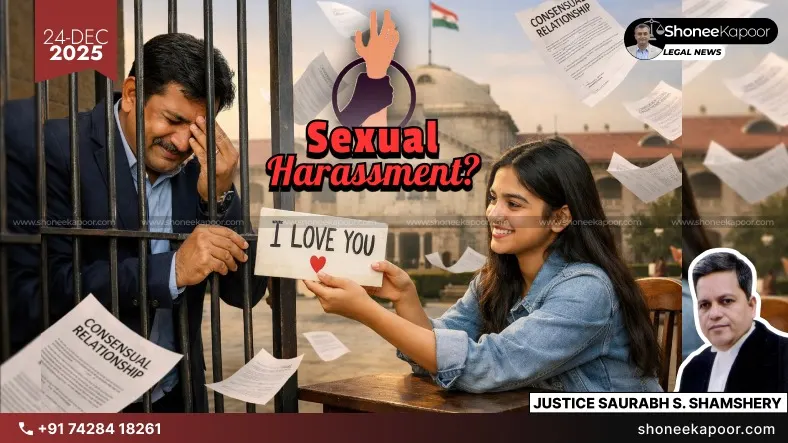
The Allahabad High Court held that a consensual relationship between a lecturer and a former student was misconduct but not sexual harassment. The Court ruled that dismissal with disqualification was excessive and sent the matter back for reconsideration of punishment.
PRAYAGRAJ: The Allahabad High Court has held that a consensual relationship between a teacher and a student amounts to misconduct but does not qualify as sexual harassment under service rules. The Court ruled that dismissal from service with disqualification was an extreme and excessive punishment and described it as “shockingly disproportionate”.
The case related to a lecturer of Motilal Nehru National Institute of Technology (MNNIT), who was removed from service after a complaint by a former woman student. The matter was heard by Justice Saurabh Shyam Shamshery, who examined both the nature of the misconduct and the proportionality of the punishment imposed.
The Court observed that while the institute was justified in taking action against the lecturer for not maintaining the sanctity of the teacher–student relationship, the penalty imposed could not be sustained. The Court held that termination from service for a consensual relationship with a student was “shockingly disproportionate”, especially when there was no criminal case, no FIR was ever registered, and the complaint was filed several years after the student had already left the institute.
The lecturer, Singh, joined MNNIT in 1999 as a Lecturer in the Computer Science and Engineering department. In February 2006, he was dismissed from service following a complaint by a former student who alleged that he had an improper relationship with her during her student years. Initially, the complainant alleged coercion, but later admitted that the relationship became consensual and continued for nearly three years, even after she had left the institute.
After receiving the complaint, the institute constituted a five-member committee. This committee did not return any clear or final finding of sexual assault. Despite this, Singh was placed under suspension. Later, the institute appointed a One-Man Inquiry Commission headed by a former High Court judge.
The Commission concluded that Singh had committed gross misconduct by showing “special favour” to the student and by engaging in a physical relationship with her while she was still enrolled at the institute. Stressing the importance of the teacher-student relationship and the moral standards expected from teachers, the Commission recommended termination from service. Acting on this recommendation, the Board of Governors dismissed Singh and also disqualified him from future employment.
Before the High Court, Singh challenged his dismissal and argued that the institute had completely ignored its own service rules. He submitted that no charge-sheet was issued, no inquiry officer or presenting officer was appointed, and he was not given the opportunity to cross-examine witnesses.
The High Court agreed that the disciplinary procedure prescribed under the service rules was not followed. However, the Court held that Singh was not prejudiced on facts because he had admitted to the relationship with the student, which continued even after she left the institute. The Court observed that even if a proper departmental inquiry had been conducted, the conclusion on misconduct would not have been materially different.
At the same time, the Court carefully examined whether the nature of the misconduct justified the extreme punishment of dismissal with disqualification. It noted that the relationship was admittedly consensual, no FIR was ever lodged by the complainant, and the complaint was made several years after she stopped being a student, following the breakdown of the relationship.
The Court also clarified that the case did not amount to sexual harassment as understood under the service rules and was essentially a case of moral impropriety. While holding that Singh failed to maintain the high moral standards expected from a teacher, the Court took note of the fact that there were no other complaints against him during his entire service.
The Court held:
“In these circumstances, termination from service with disqualification is shockingly disproportionate.”
The Court further observed that the case may justify a lesser or minor punishment rather than a major penalty like dismissal.
The Court also recorded the following observation:
“No doubt the petitioner has not followed or kept high standard of morality but there is another factor that except the said allegation there is no other allegation against petitioner despite he was doing job for almost three years before the order of termination was passed. In case petitioner got married with complainant after their relationship of three years, possibly no complaint was filed”
In view of these findings, the Allahabad High Court interfered with the dismissal order only to the extent of punishment. The matter was remitted back to the disciplinary authority of MNNIT to reconsider the quantum of punishment in light of the Court’s observations. With these directions, the writ petition was disposed of.
Explanatory Table: Laws & Sections Referred In The Case
| Law / Rule / Provision | Section / Clause | Simple Explanation (Indian English) | How It Was Used in This Case |
| State Universities Act, 1973 | Section 49-A | Lays down expected conduct and discipline standards for teachers | Referred to by the Inquiry Commission to say a teacher must maintain high moral conduct |
| State Universities Act, 1973 | Section 49-D | Deals with penalties and disciplinary action against teachers | Used by the Inquiry Commission to recommend termination |
| First Statutes of University of Allahabad, 1976 | Clause 16.04 | Provides for major penalties including termination | Basis for recommending dismissal from service |
| Administrative Orders of MNNIT | Para 3 (Serial iv–vii) | Lists major penalties like reduction in rank, compulsory retirement, removal or dismissal | Court held dismissal under these provisions was excessive |
| Administrative Orders of MNNIT | Para 3 (Serial i–iii) | Lists minor penalties like censure or withholding increments | Court observed that a minor penalty may be more appropriate |
| MNNIT Disciplinary Procedure Resolution | Para 8 | Prescribes procedure for imposing penalties and holding inquiry | Court found this procedure was not properly followed |
| Principles of Natural Justice | — | Right to notice, hearing, cross-examination, and fair inquiry | Court noted violations but held no factual prejudice due to admission |
| Sexual Harassment (Service Law Concept) | — | Requires unwelcome conduct or coercion | Court held the case was not sexual harassment but consensual conduct |
| Service Jurisprudence | Doctrine of Proportionality | Punishment must match the gravity of misconduct | Court applied this doctrine to set aside dismissal |
Case Summary
- Case Title: Rajesh Singh vs Board of Governors, Motilal Nehru National Institute of Technology and Another
- Court: High Court of Judicature at Allahabad
- Case Number: Writ – A No. 19080 of 2006
- Date Reserved: 03.12.2025
- Date Delivered: 16.12.2025
- Bench: Hon’ble Justice Saurabh Shyam Shamshery
- Counsels for Petitioner
- Abhishek Srivastava
- Arvind Srivastava
- Ashwani Kumar Mishra
- Manish Tandon
- Rahul Srivastava
- Shashi Nandan
- Suneet Kumar
- Counsels for Respondents
- C.S.C.
- Shivendu Ojha
Key Facts In Brief
- Petitioner joined MNNIT in 1999 as a Lecturer in Computer Science and Engineering
- Complaint filed by a former woman student in 2003, years after leaving the institute
- Relationship admitted to be consensual and continued after student left
- No FIR or criminal proceedings were ever initiated
- One-Man Inquiry Commission recommended termination on moral grounds
- Lecturer dismissed with disqualification in 2006
Core Findings Of The High Court
- Disciplinary procedure prescribed by institute rules was not strictly followed
- However, petitioner was not factually prejudiced as relationship was admitted
- Case did not amount to sexual harassment under service rules
- Misconduct was moral impropriety, not criminal or coercive behaviour
- No other complaints against the lecturer during service
- Punishment of dismissal with disqualification was held excessive
Final Outcome
The Allahabad High Court set aside the dismissal only on the issue of punishment and sent the matter back to the disciplinary authority to reconsider the quantum of punishment in light of proportionality and fairness principles.
Key Takeaways
- Consensual relationships, even if morally questionable, cannot be automatically branded as sexual harassment to destroy a man’s career.
- Punishment in service matters must be proportional; dismissal with lifelong disqualification for a consensual relationship is legal overkill.
- Delayed complaints filed years after a relationship ends, without any FIR or criminal case, deserve strict judicial scrutiny.
- Moral policing cannot replace due process; institutions must follow their own disciplinary rules before punishing any man.
- This judgment reinforces that men cannot be made scapegoats merely on allegations when facts show consent and absence of criminality.
This Could Change Your Case-Get FREE Legal Advice-Click Here!
Disclaimer: The views and opinions expressed in this article are those of the Indian courts and do not necessarily reflect the official policy or position of “ShoneeKapoor.com” or its affiliates. This article is intended for informational and educational purposes only. The content provided is not legal advice, and viewers should not act upon this information without seeking professional counsel. Viewer discretion is advised.