
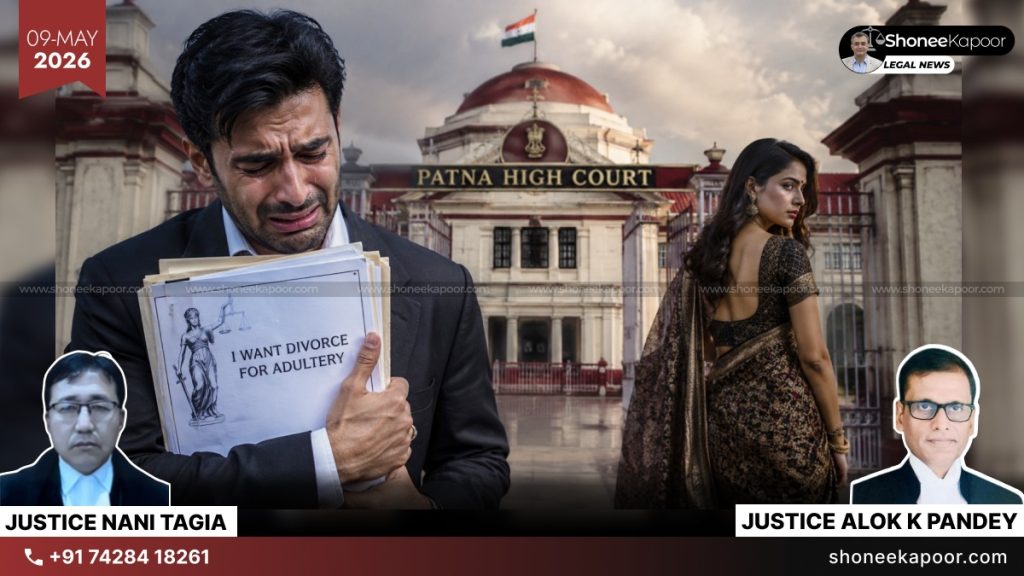
Could A Husband Get Divorce Only On Suspicion Of Adultery? Patna HC Gives Important Warning
BIHAR: The Patna High Court refused to grant divorce to a husband after finding that his adultery allegations against his wife were vague, unsupported, and lacking proper details. The Court also made it clear that courts cannot rely on evidence which goes beyond the original pleadings filed in a case.
The judgment came in an appeal filed by a husband against a 2019 order of the Family Court, Siwan, which had dismissed his divorce petition even though the wife did not appear before the court and the matter proceeded ex parte.
A Division Bench of Justice Nani Tagia and Justice Alok Kumar Pandey held that mere allegations, suspicion, or broad accusations are not enough to dissolve a marriage under law.
According to the husband, the marriage took place in 2003 and the relationship remained normal for around two years. He alleged that later the wife’s behaviour changed and she started visiting markets without informing family members. He further claimed that on 15 October 2012, she left home at 11 a.m. and returned around 9 p.m., after which he allegedly saw her coming out of a cinema hall with another man. He later claimed to have learnt that she was in a relationship with one Dhananjay Tiwary even before marriage.
The husband argued before the High Court that the Family Court ignored witness statements and failed to appreciate evidence showing that the wife was allegedly seen with different men and had left the matrimonial home without consent. He also argued that since the wife never appeared despite notice, the court should have granted divorce ex parte.
However, the High Court found serious defects in the divorce petition itself. The Bench noted that the husband failed to mention proper details such as the exact time, place, and identity of the alleged relationship. The Court also pointed out that the alleged paramour was never made a party in the proceedings.
The Court observed:
“The allegation of adultery is made against the respondent/wife without revealing the name of person who was accompanying respondent and the person against whom allegation is made has not been made party. The allegation is vague…”
The Bench further noted that except for one alleged incident dated 15.10.2012, no specific incident, circumstance, date, or conduct was mentioned between 2003 and 2012. The Court said the husband only made general statements that the wife became “indisciplined” after two years of marriage without giving concrete particulars.
The Court also agreed with the Family Court that although witnesses spoke about an alleged relationship with Dhananjay Tiwary, no independent witness from the concerned village was produced to support the allegations. Even the alleged paramour himself was not impleaded in the case.
While examining the evidence, the High Court found that several claims made later during witness testimony were never originally pleaded in the divorce petition. The Bench observed that many allegations appeared to be based only on suspicion, assumptions, and conjectures rather than legally admissible proof.
Importantly, the Court reiterated the settled legal principle that evidence beyond pleadings cannot be considered for granting relief. It stated that parties cannot introduce new facts during evidence if those facts were never properly pleaded earlier in the case.
The Court relied upon multiple Supreme Court judgments and observed:
“Relief not founded on the pleadings should not be granted. A decision of a case cannot be based on grounds outside the pleadings of the parties.”
The Bench further quoted the Supreme Court and observed:
“No amount of evidence can be looked into, upon a plea which was never put forward in the pleadings.”
The High Court finally held that the Family Court had correctly appreciated the material available on record and there was no reason to interfere with the order dismissing the husband’s divorce plea. The appeal was accordingly dismissed.
Important Laws And Legal Principles Discussed In The Case
| LAW / SECTION / CASE LAW | EXPLANATION | HOW COURT APPLIED IT |
| Section 13, Hindu Marriage Act, 1955 | Provides grounds for divorce including adultery, cruelty, desertion etc. | Court held that proper ingredients of adultery were not pleaded or proved. |
| Law of Pleadings | Parties must clearly state all material facts in pleadings before leading evidence. | Court ruled that evidence beyond pleadings cannot be considered. |
| Adultery Principle | Allegation of adultery requires clear particulars like name, time, place, circumstances. | Court found allegations completely vague and unsupported. |
| Necessary Party Principle | Alleged adulterer/paramour should generally be impleaded in adultery-based matrimonial litigation. | Court noted alleged paramour was never made party. |
| Ex Parte Proceedings | Even if opposite party does not appear, court still requires legal proof. | Court refused automatic divorce merely because wife remained absent. |
| National Textile Corporation Ltd. Vs. Nareshkumar Badrikumar Jagad & Ors. (2011) 12 SCC 695 | Supreme Court held relief cannot be granted beyond pleadings. | Relied upon to reject evidence outside pleadings. |
| Trojan & Co. Vs. Nagappa Chettiar AIR 1953 SC 235 | Courts cannot decide cases on grounds not pleaded. | Referred through Supreme Court precedent discussion. |
| State of Maharashtra Vs. Hindustan Construction Co. Ltd. (2010) 4 SCC 518 | Pleadings define scope of litigation. | Used to reinforce procedural discipline. |
| Kalyan Singh Chouhan Vs. C.P. Joshi (2011) 11 SCC 786 | Evidence outside pleadings should not be relied upon. | Supported rejection of unsupported allegations. |
| Prakash Rattan Lal Vs. Mankey Ram ILR (2010) III Delhi 315 | Parties cannot travel beyond pleadings while leading evidence. | Court reiterated no surprise facts can be introduced later. |
| Ram Sarup Gupta Vs. Bishun Narain Inter College (1987) 2 SCC 555 | Evidence without pleadings cannot be considered. | Used to reinforce settled civil law principle. |
| Harihar Prasad Singh Vs. Balmiki Prasad Singh (1975) 1 SCC 212 | Pleadings bind parties to their stated case. | Referred regarding procedural fairness. |
| Bachhaj Nahar Vs. Nilima Mandal (2008) 17 SCC 491 | Courts cannot grant relief outside pleadings or framed issues. | Extensively relied upon by High Court. |
Case Details
| PARTICULARS | DETAILS |
| Case Title | Shyam Bihari Mishra vs Sanju Devi |
| Court | Patna High Court |
| Case Number | Miscellaneous Appeal No. 92 of 2020 |
| Date of Judgment | 04.05.2026 |
| Bench | Justice Nani Tagia and Justice Alok Kumar Pandey |
| Appellant | Shyam Bihari Mishra |
| Respondent | Sanju Devi |
| Counsel for Appellant | Mr. Dhanendra Chaubey, Advocate |
| Counsel for Respondent | None Appeared |
| Trial Court | Principal Judge, Family Court, Siwan |
| Trial Court Case | Divorce Case No. 216 of 2012 |
| Result | Appeal Dismissed; Divorce Refused |
| Main Issue | Whether vague adultery allegations without proper pleadings and proof can justify divorce |
| Key Observation | Suspicion and broad allegations are insufficient for divorce on adultery grounds |
Key Takeaways
- Even if a wife never appears in court, husbands still face an extremely high burden to prove adultery and desertion.
- Courts require exact dates, places, names, and technical pleadings from husbands — suspicion, conduct, and surrounding circumstances are often treated as insufficient.
- The husband’s allegations were rejected mainly because the alleged paramour was not impleaded and details were considered “vague”.
- Indian matrimonial litigation increasingly operates on procedural technicalities, where a man’s lived experiences alone may not satisfy evidentiary standards.
- The judgment reinforces that in family disputes, men cannot rely on assumptions or emotional claims — every allegation must be legally documented from the very beginning.
This Could Change Your Case-Get FREE Legal Advice-Click Here!
Disclaimer: The views and opinions expressed in this article are those of the Indian courts and do not necessarily reflect the official policy or position of “ShoneeKapoor.com” or its affiliates. This article is intended for informational and educational purposes only. The content provided is not legal advice, and viewers should not act upon this information without seeking professional counsel. Viewer discretion is advised.