
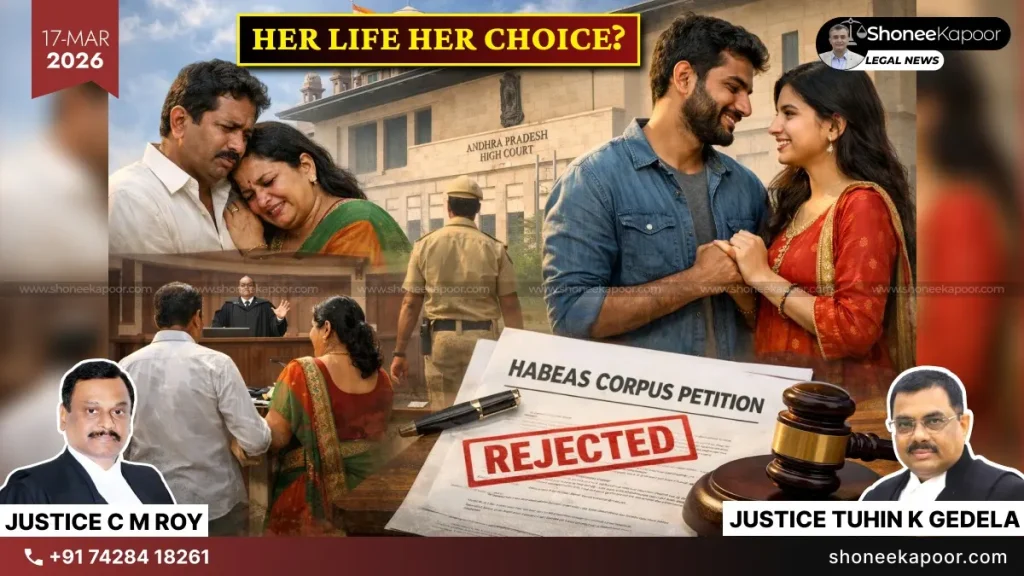
The Andhra Pradesh High Court held that an adult woman’s choice is final and dismissed the habeas corpus petition filed by her parents, as there was no illegal detention.
AMARAVATI: In a strong decision favouring personal choice and preventing misuse of law against men, the Andhra Pradesh High Court led by Justice Cheekati Manavendranath Roy and Justice Tuhin Kumar Gedela refused to interfere in a habeas corpus petition filed by parents seeking custody of their adult daughter. The Court made it clear that once a woman becomes major, she has full legal freedom to decide her life, including marriage and where she wants to live.
The Court verified her age and recorded that she is a major, noting that this fact was not denied by her parents. The girl firmly refused to go back with them even after interaction and clearly expressed her wish to stay with her husband. This became the decisive factor in the case.
The judges made a clear legal position and observed:
“Therefore, as she has with free will and volition voluntarily married respondent No.7 after attaining majority and she has expressed her intention to live and stay with him only, it cannot be said that she has been illegally confined or detained by respondent No.7.”
The Court further reinforced the autonomy of an adult woman by stating:
“As she is a major, she has every right to take a decision as to with whom she intends to stay and live.”
On the maintainability of the case, the Court categorically held, “Therefore, the writ petition for Habeas Corpus is not maintainable.”
Even after giving an opportunity to the parents to speak with their daughter, the Court noted that she remained firm in her decision and therefore permitted her to continue living with her husband.
The parents also alleged that the relationship began when she was a minor and that the police failed to act earlier. On this issue, the Court clarified that such grievances can be pursued through appropriate legal remedies, but they cannot be used to sustain a habeas corpus petition.
In conclusion, the High Court dismissed the petition and upheld the woman’s right to choose her partner, making it clear that courts will not allow misuse of habeas corpus to interfere in voluntary relationships or to harass men when the woman is acting on her own free will.
Explanatory Table: Laws & Sections Involved
| Law / Section | Explanation (Simple Indian English) | Role in Case |
| Article 226 of Constitution of India | Gives High Courts power to issue writs like habeas corpus | Petition filed under this to bring daughter back |
| Writ of Habeas Corpus | Legal remedy to produce a person alleged to be illegally detained | Court said not applicable as no illegal detention |
| Section 151 CPC | Inherent powers of Court to pass orders for justice | Used for interim requests like custody |
| POCSO Act, 2012 | Law to protect minors from sexual offences | Parents alleged offence under this |
| Bharatiya Nyaya Sanhita, 2023 | New criminal law replacing IPC | Allegations sought under this law |
| Sakiri Vasu vs State of UP (2008) | Supreme Court case on remedy when police don’t act | Court said parents can use proper remedy, not habeas corpus |
Case Details
- Case Title: Turlapati Peddabbai & Another vs State of Andhra Pradesh & Others
- Case Number: Writ Petition No. 4349 of 2026
- Court: High Court of Andhra Pradesh at Amaravati
- Date of Judgment: 03 March 2026
- Bench: Justice Cheekati Manavendranath Roy & Justice Tuhin Kumar Gedela
- Counsels:
- For Petitioners: M.M.M. Srinivasa Rao
- For Respondents: Advocate General (for State)
Key Takeaways
- Courts have made it clear that once a woman is major, her choice of partner cannot be questioned or overridden by parents.
- Habeas corpus cannot be filed to break consensual relationships or to target men when there is no illegal detention.
- The man was protected from wrongful confinement allegations because the woman herself confirmed voluntary relationship and marriage.
- False or delayed allegations cannot be casually used in such cases and must follow proper legal process separately.
- Many men face harassment due to emotional pressure tactics by families, but this ruling makes it clear that such tactics won’t work in court.
This Could Change Your Case-Get FREE Legal Advice-Click Here!
Disclaimer: The views and opinions expressed in this article are those of the Indian courts and do not necessarily reflect the official policy or position of “ShoneeKapoor.com” or its affiliates. This article is intended for informational and educational purposes only. The content provided is not legal advice, and viewers should not act upon this information without seeking professional counsel. Viewer discretion is advised.