
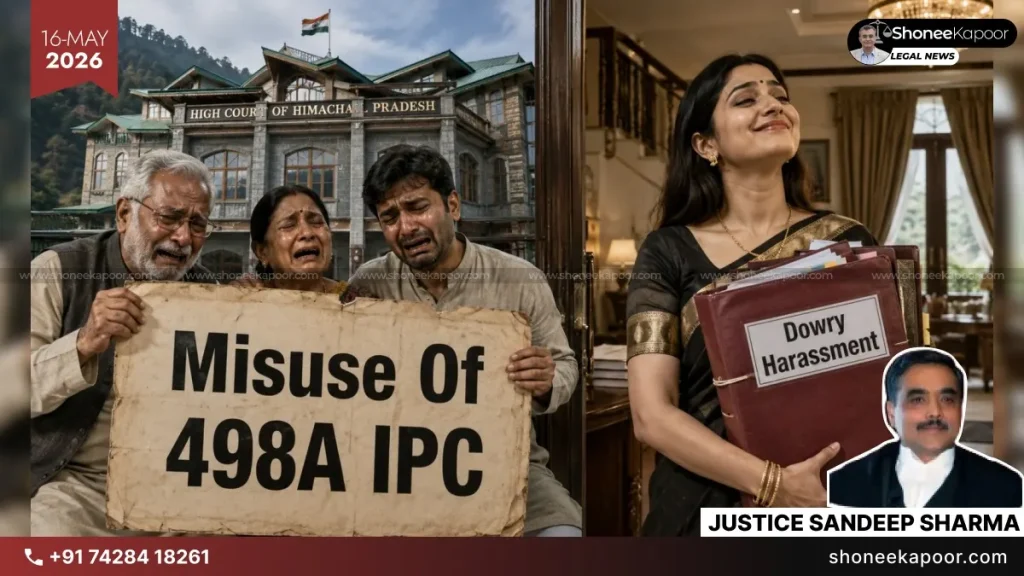
Can selling a matrimonial house become a dowry harassment case under Section 498A IPC? The Himachal Pradesh High Court has now answered this important question.
SHIMLA: The Himachal Pradesh High Court has ruled that merely selling a matrimonial house cannot automatically be treated as dowry harassment under Section 498A of the Indian Penal Code. The Court observed that allegations must clearly show dowry demand or harassment connected to unlawful property demands before criminal liability under Section 498A can arise.
Justice Sandeep Sharma passed the judgment while quashing FIR No. 99 of 2022 registered at Police Station Baijnath, Kangra, against Rahul Dadhwal and his family members.
The Court specifically observed:
“In status report, it has come that matrimonial house of the complainant situate at Delhi was sold by the petitioners, but such act, if any, cannot be construed to be act of demanding dowry.”
As per the case records, complainant Anjali Rana alleged that her marriage with Rahul Dadhwal was solemnised on October 11, 2021, in Ghaziabad according to Hindu customs. She claimed that on February 27, 2022, her husband and in-laws left her at her parental home in Himachal Pradesh and told her she would later be taken back to her matrimonial home.
She further alleged that nobody from the husband’s family contacted her afterward. When she and her father visited the matrimonial home in Delhi on April 4, 2022, they allegedly found the house locked. Later, she came to know that the family had shifted elsewhere. She also stated that her belongings were still with her in-laws. Based on these allegations, an FIR under Sections 498A, 406 and 34 IPC was registered.
During the proceedings, the High Court noted that both parties had already dissolved their marriage through mutual consent before the Family Court. The Court recorded that both sides had clearly stated they had settled all disputes amicably and nothing remained to be exchanged between them.
The complainant had also stated before the Family Court:
“हमारा कोई लेन-देन शेष न बचा है”.
The husband’s counsel argued that there were no allegations of dowry demand in the FIR and that the dispute mainly arose because the complainant was left at her parental home and later found the matrimonial house locked.
The complainant later claimed before the High Court that some gold ornaments and belongings had not been returned. However, the Court noted that no written settlement or supporting document regarding return of ornaments was ever produced before it. The Court also recorded that the petitioners had offered ₹1 lakh in lieu of the ornaments, but the complainant did not accept the offer.
While examining Section 498A IPC, the High Court observed that cruelty under the law requires either grave physical or mental harassment or coercion connected to unlawful demands for property or valuable security.
The Court found that the FIR did not contain any allegation that the husband or his relatives demanded dowry or harassed the complainant for bringing insufficient dowry. It observed that the core allegation was only that she was not taken back from her parental house and later found the matrimonial home locked.
The Court further held:
“Since basic ingredients of Section 498-A of IPC are totally missing in the case at hand…”
The High Court also observed that continuing criminal proceedings in such circumstances would unnecessarily force the accused to undergo a prolonged criminal trial despite the case lacking the essential ingredients required under Section 498A IPC.
Accordingly, the Himachal Pradesh High Court quashed the FIR and all consequential criminal proceedings against the husband and his family members.
Explanatory Table Of All Laws And Sections Mentioned In The Case
| LAW / SECTION | MEANING | HOW IT WAS USED IN THIS CASE |
| Section 498A IPC | Deals with cruelty or harassment by husband or relatives, especially linked to dowry demands | Court held essential ingredients of dowry harassment were missing |
| Section 406 IPC | Criminal breach of trust regarding entrusted property or belongings | Invoked regarding alleged non-return of articles and belongings |
| Section 34 IPC | Common intention among multiple accused persons | Added because allegations were against husband and family members together |
| Section 528 BNSS | Inherent powers of High Court to prevent abuse of legal process (earlier Section 482 CrPC) | Petition filed under this section seeking quashing of FIR |
| Section 13-B Hindu Marriage Act | Mutual consent divorce provision | Husband and wife obtained divorce through mutual consent |
| Section 173 CrPC | Filing of police final report/charge-sheet after investigation | Court referred to status report and filing of challan |
| Section 156(1) CrPC | Police power to investigate cognizable offences | Mentioned in Supreme Court precedents cited in judgment |
| Section 155(2) CrPC | Magistrate’s approval for non-cognizable offence investigation | Mentioned while discussing quashing principles |
| Section 482 CrPC | Inherent powers of High Court to quash proceedings (old provision before BNSS) | Extensively discussed through Supreme Court judgments |
Important Supreme Court Judgments Relied Upon By The High Court
| JUDGMENT | PRINCIPLE MENTIONED |
| State of Karnataka v. L. Muniswamy (1977) 2 SCC 699 | High Court can quash proceedings to prevent abuse of process |
| State of Haryana v. Bhajan Lal, 1992 Supp (1) SCC 335 | Landmark principles for quashing FIRs |
| Vineet Kumar v. State of U.P. | Criminal law should not become a weapon of harassment |
| Prashant Bharti v. State (NCT of Delhi) | Courts can quash proceedings where allegations do not disclose offence |
| Rajiv Thapar v. Madan Lal Kapoor | Conditions for exercising inherent powers to quash proceedings |
| Anand Kumar Mohatta v. State (NCT of Delhi) | High Court can interfere even after filing of charge-sheet |
| Pramod Suryabhan Pawar v. State of Maharashtra | Scope of powers under Section 482 CrPC |
Case Details
| PARTICULARS | DETAILS |
| Case Title | Rahul Dadhwal & Others vs State of Himachal Pradesh & Others |
| Case Number | Cr.MMO No. 1083 of 2025 |
| Court | High Court of Himachal Pradesh, Shimla |
| Bench | Hon’ble Mr. Justice Sandeep Sharma |
| Date of Decision | 05.05.2026 |
| Neutral Citation | 2026:HHC:14728 |
| Petition Filed Under | Section 528 of Bharatiya Nagarik Suraksha Sanhita (BNSS) |
| FIR Number | FIR No. 99 dated 01.06.2022 |
| Police Station | Police Station Baijnath, District Kangra, Himachal Pradesh |
| Sections Invoked In FIR | Sections 498A, 406 and 34 IPC |
| Petitioners’ Counsel | Mr. Yug Singhal, Advocate |
| State Counsel | Mr. Rajan Kahol & Mr. Vishal Panwar, Additional Advocate Generals with Mr. Ravi Chauhan & Mr. Anish Banshtu, Deputy Advocates General |
| Complainant’s Counsel | Mr. Abhimanyu Rathour and Ms. Poonam Gehlot, Advocates |
Key Takeaways
- Himachal Pradesh High Court clearly held that selling a matrimonial house does not automatically amount to dowry harassment under Section 498A IPC.
- The Court found no allegation of dowry demand, coercion, or unlawful property demand despite a full criminal case being filed against the husband and his family.
- Mere marital breakdown, locked house allegations, or property disputes cannot be converted into criminal cruelty cases to drag entire families into trial.
- Even after mutual divorce and settlement statements before the Family Court, the husband’s family was forced to continue facing criminal prosecution for years.
- The judgment exposes how Section 498A is repeatedly stretched beyond its legal scope, turning matrimonial disputes into tools of pressure and harassment against men and their parents.
This Could Change Your Case-Get FREE Legal Advice-Click Here!
Disclaimer: The views and opinions expressed in this article are those of the Indian courts and do not necessarily reflect the official policy or position of “ShoneeKapoor.com” or its affiliates. This article is intended for informational and educational purposes only. The content provided is not legal advice, and viewers should not act upon this information without seeking professional counsel. Viewer discretion is advised.