
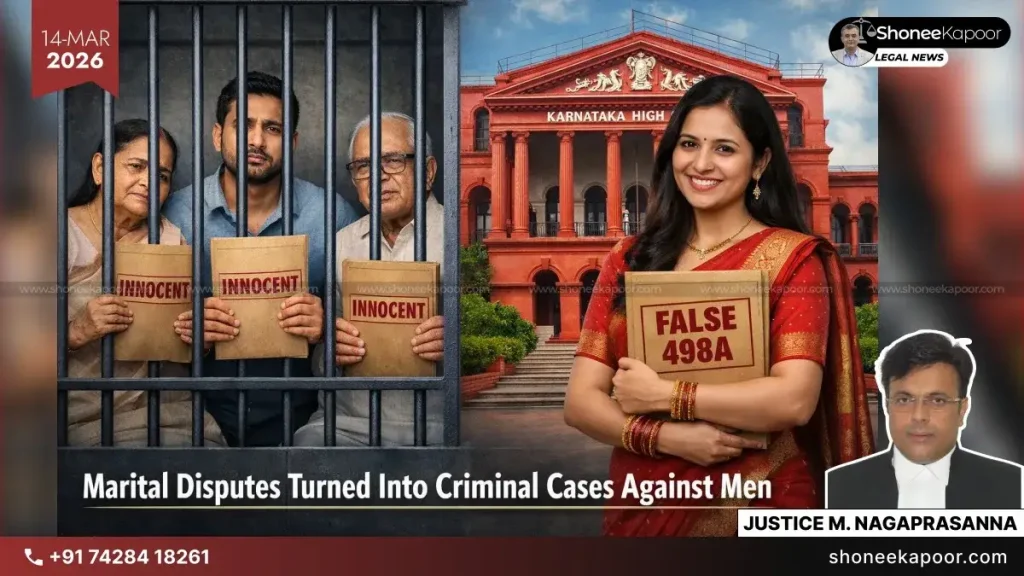
Can normal marriage disagreements be treated as criminal cruelty under Section 498A? Karnataka High Court says NO – strong remarks expose how ordinary disputes can turn into criminal cases.
BENGALURU: The Karnataka High Court has clarified an important point regarding Section 498A of the IPC, stating that the law is meant only for serious cases of cruelty and not for ordinary marital disagreements or compatibility issues.
While quashing a criminal case filed by a wife against her husband and his family, the court made it clear that not every dispute inside a marriage can be treated as a crime.
The case was heard by Justice M. Nagaprasanna. The court observed that many matrimonial disagreements may arise between couples, but criminal law cannot be used as a solution for every unhappy marriage.
The court said:
“The law does not criminalize incompatibility, nor does it punish imperfect marriages. Section 498A of the IPC is not a panacea for all matrimonial ills.”
The judge further explained the real intention behind Section 498A. The provision was created to deal with serious cruelty that threatens the safety or mental well-being of a spouse, especially in cases connected with dowry harassment.
Justice Nagaprasanna stated:
“It is a targeted provision meant to address grave cruelty, conduct so wilful and pernicious so as to imperil life, limb or mental health or even harassment tethered to unlawful demands of dowry. This is the purport of the provision – 498A.”
The case was filed by a woman against her husband Abuzar Ahmed and his family members. Based on her complaint, the police registered a case under Sections 498A and 504 of the IPC along with Sections 3 and 4 of the Dowry Prohibition Act, 1961.
According to the facts placed before the court, the couple got married on 25 August 2017. Soon after marriage they moved to the United States where Ahmed was working. The couple lived abroad for almost six years and also had a child during this period.
In January 2023, the wife returned to India. After coming back, she filed a criminal complaint against not only her husband but also his father, mother and brother. The complaint led to the registration of a criminal case for offences under Sections 498A and 504 read with Section 34 of the IPC.
The husband and his family approached the High Court seeking to quash the FIR. They argued that the complaint was a misuse of Section 498A and that allowing such cases to continue would result in harassment of innocent family members.
They also pointed out that after the case was registered, a Look Out Circular was issued against the husband, which prevented him from travelling outside India and affected his ability to work abroad.
On the other hand, the complainant opposed the petition and argued that the allegations clearly showed harassment by the husband and in-laws. She requested the court to allow the police investigation to continue.
After examining the complaint carefully, the High Court noted that the allegations mainly related to domestic disagreements and expectations inside the household.
The court observed:
“A careful reading of the complaint reveals grievances such as dietary restrictions, expectations regarding attire, allocation of household responsibilities, disagreements over television preferences laced with a statement that the husband treated the complainant/wife as his servant. These allegations, even if accepted at face value, portray a portrait of marital discord, but fall woefully short of depicting the statutory cruelty contemplated under Section 498A of the IPC.”
The judge also remarked that minor arguments and disagreements between husband and wife cannot automatically be converted into criminal offences under Section 498A or Section 504 IPC.
The court further expressed concern about the manner in which the police registered the case without conducting a preliminary inquiry as required by the Supreme Court.
Justice Nagaprasanna stated:
“It is shocking as to how without any preliminary inquiry as directed by the Apex Court in the case of LALITA KUMARI v. STATE OF UTTAR PRADESH [(2014)2 SCC 1], the complaint is even registered, by the jurisdictional police and above all, the husband is stopped from moving away from the shores of the nation on frivolous allegations.”
While analysing the complaint, the court found that there was no claim of dowry demand and no allegation of extreme cruelty that would meet the legal requirements of Section 498A.
The judgment noted:
“There is neither an allegation of demand of dowry nor any conduct of such severity as would shock the conscience or satisfy the statutory threshold.”
Considering these facts, the High Court concluded that continuing the criminal proceedings would only result in unnecessary harassment and misuse of judicial time.
The court finally ruled:
“The allegations in the case at hand, even at their highest, do not constitute the offence alleged, they are in fact inherently improbable. The continuation of investigation would serve no purpose other than to prolong harassment, stigmatize the petitioners and squander the precious time of criminal Courts. The issuance of a look out circular against the 1st petitioner, on allegations so tenuous, would only compound injustice. Therefore, to permit the criminal process to lumber forward would be to allow law to become a weapon rather than a remedy. I thus deem it appropriate to exercise my jurisdiction under Section 482 of the Cr.P.C. and obliterate the very registration of crime against these petitioners, to prevent it becoming an abuse of the process of the law and resulting in miscarriage of justice.”
With these observations, the Karnataka High Court quashed the FIR and all criminal proceedings against the husband and his family, reiterating that Section 498A must be applied only in genuine cases of serious cruelty and not for ordinary marital disagreements.
Explanatory Table : Laws And Sections Mentioned In The Case
| Law / Section | Statute | Meaning / Legal Scope | Relevance In This Case |
| Section 498A IPC | Indian Penal Code | Punishes husband or relatives for cruelty against a married woman including harassment linked to dowry or conduct causing grave physical or mental harm. | Wife alleged cruelty and harassment against husband and his family. Court found allegations did not meet legal threshold of cruelty. |
| Section 504 IPC | Indian Penal Code | Punishment for intentional insult intended to provoke breach of peace. | Included in FIR but allegations were not sufficient to sustain prosecution. |
| Section 34 IPC | Indian Penal Code | Acts done by several persons in furtherance of common intention. | Used in FIR to implicate multiple family members together. |
| Section 3 Dowry Prohibition Act, 1961 | Dowry Prohibition Act | Penalizes giving or taking dowry; minimum imprisonment of five years and fine. | Alleged dowry demand in complaint but court found absence of specific material supporting such demand. |
| Section 4 Dowry Prohibition Act, 1961 | Dowry Prohibition Act | Punishes direct or indirect demand for dowry from bride or her family. | Included in FIR but court observed no concrete dowry demand allegations. |
| Section 482 CrPC | Code of Criminal Procedure | Inherent power of High Court to quash criminal proceedings to prevent abuse of law and secure justice. | Petition filed under this section to quash FIR and proceedings. Court exercised this power to quash the case. |
| Lalita Kumari v State of Uttar Pradesh (2014) | Supreme Court precedent | Requires preliminary inquiry in certain cases before registering FIR. | Court criticised police for registering FIR without preliminary inquiry. |
| Bhajan Lal Guidelines (1992) | Supreme Court precedent | Provides categories where FIR can be quashed for abuse of process. | Court relied on principles to determine that allegations were vague and improbable. |
Case Details
| Particular | Details |
| Case Title | Abuzar Ahmed & Others v. State of Karnataka & Others |
| Court | High Court of Karnataka at Bengaluru |
| Case Number | Criminal Petition No. 7053 of 2024 |
| Judgment Reserved On | 27.11.2025 |
| Judgment Pronounced On | 08.01.2026 |
| Bench / Coram | Hon’ble Mr. Justice M. Nagaprasanna |
| Petition Filed Under | Section 482 of the Code of Criminal Procedure |
| FIR Details | Crime No. 90 of 2024 |
| Police Station | Basavanagudi Women Police Station, Bengaluru |
| Trial Court | 37th Additional Chief Metropolitan Magistrate Court, Bengaluru |
| Final Result | FIR Quashed Against Husband And In-Laws |
| Order Passed | Criminal Petition Allowed; FIR Quashed |
Parties In The Case
| Role | Name |
| Petitioner No.1 | Abuzar Ahmed |
| Petitioner No.2 | Saud Ahmed |
| Petitioner No.3 | Marzia Saud |
| Petitioner No.4 | Faizan Ahmed |
| Respondent No.1 | State of Karnataka |
| Respondent No.2 | Ruman Asad |
| Respondent No.3 | Bureau of Immigration |
Advocates / Counsels Appearing
| Side | Advocate |
| Petitioners | Sri Syed Khaleel Pasha, Advocate |
| Respondent No.1 (State) | Sri B.N. Jagadeesha, Additional State Public Prosecutor |
| Respondent No.2 (Complainant) | Sri Naveed Ahmed, Advocate |
| Respondent No.3 (Immigration) | Sri H. Shanthi Bhushan, Deputy Solicitor General of India |
Key Takeaways
- 498A Is Not Meant For Every Marital Dispute
The court clearly stated that incompatibility, household disagreements, or an imperfect marriage cannot be turned into criminal cruelty. - Entire Families Are Often Dragged Into Cases Without Evidence
Parents-in-law and siblings are frequently named in complaints despite having little or no role in the alleged dispute. - Vague Allegations Cannot Justify Criminal Prosecution
The judgment highlights that general accusations without specific incidents, dates, or proof cannot meet the legal threshold of cruelty. - Police Must Not Register FIRs Blindly
The court criticised the police for registering the case without proper preliminary inquiry, showing how easily criminal machinery can be triggered against men. - Criminal Law Cannot Become A Tool Of Harassment
The High Court emphasized that allowing such cases to continue only prolongs harassment, stigmatizes the accused, and wastes valuable court time.
This Could Change Your Case-Get FREE Legal Advice-Click Here!
Disclaimer: The views and opinions expressed in this article are those of the Indian courts and do not necessarily reflect the official policy or position of “ShoneeKapoor.com” or its affiliates. This article is intended for informational and educational purposes only. The content provided is not legal advice, and viewers should not act upon this information without seeking professional counsel. Viewer discretion is advised.