
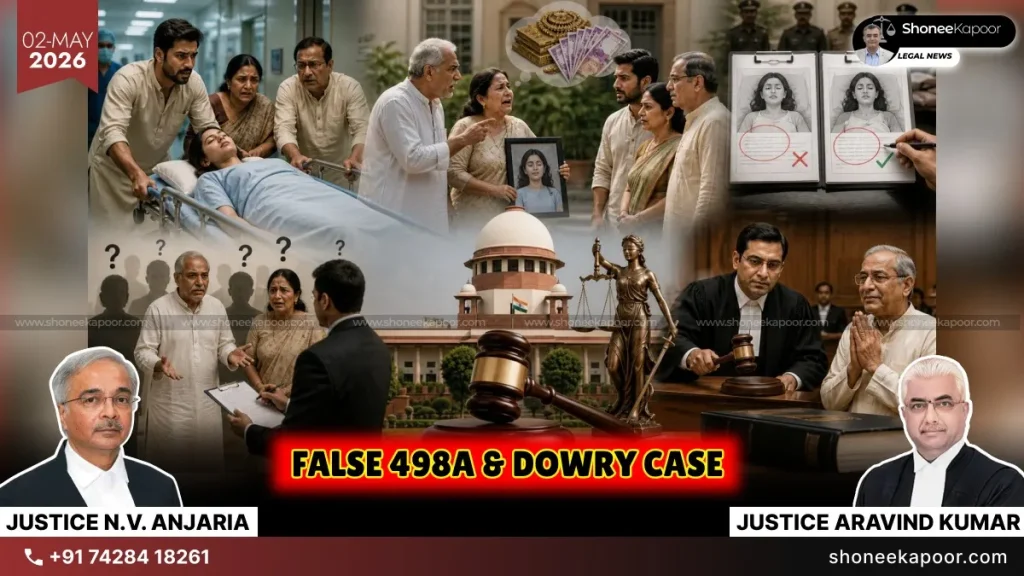
The Supreme Court found no proof of dowry demand or cruelty and acquitted the father-in-law, holding the evidence unreliable and insufficient.
When the final outcome is acquittal due to lack of proof, who compensates the man for the years lost, reputation damaged, and life disrupted?
NEW DELHI: In a judgment dated 30 April 2026, Justice Aravind Kumar of the Supreme Court dealt with a tragic 498a dowry death case of a young woman who died of burn injuries within nine months of her marriage.
The case initially appeared serious, with allegations of dowry harassment and murder against the husband and in-laws. However, as the Court examined the evidence closely, the entire prosecution story began to weaken.
The prosecution claimed that the woman was harassed for dowry and was set on fire by her husband and in-laws. Her first dying declaration supported this version, stating that her in-laws had “stuffed cloth into her mouth and poured kerosene all over her and had set her on fire.” But the very next day, in a second dying declaration, she completely changed her version and stated that “she poured the Kerosene on herself and set herself on fire.” This contradiction became the turning point of the case.
The Court carefully examined both statements and found serious doubts. It noted that during the first statement, people were present, and one person had even instructed her on what to say. This raised suspicion of tutoring. Because of this, the Court found the second statement more reliable.
Family members of the deceased also alleged dowry harassment, but their statements were inconsistent. The Court observed that important facts like dowry demand were missing in their earlier police statements and appeared later in court, suggesting an afterthought. It clearly stated that such improvements weaken credibility and cannot be blindly relied upon.
Even independent witnesses did not support the prosecution. Neighbours turned hostile and some even said relations in the family appeared normal. The Court also found it important that the accused themselves took the victim to the hospital, which did not support the theory of a planned murder.
While discussing the law on dying declarations, the Court referred to Khushal Rao v. State of Bombay (1958) and reiterated the principle that:
“It cannot be laid down as an absolute rule of law that a dying declaration cannot form the sole basis of conviction.”
But such evidence must be carefully tested based on surrounding circumstances.
The Court further relied on settled criminal law principles laid down in Sharad Birdhichand Sarda v. State of Maharashtra (1984) and State of U.P. v. Ashok Kumar Srivastava (1992), emphasizing that if two views are possible, the one favouring the accused must be accepted. It reiterated that “circumstances cannot take the place of proof” and guilt must be proven beyond reasonable doubt.
Importantly, the Court also made a strong observation on misuse of law, noting that in some cases family members are unnecessarily dragged in without specific roles, and it stated that:
“Law should not be used to take grudges against all the members of the family, even in the absence of any role attributable to them.”
Finally, the Supreme Court concluded that the prosecution failed to prove dowry demand or cruelty against the father-in-law. The evidence was found unreliable and insufficient. As a result, his conviction under Section 498A IPC was set aside, and he was fully acquitted. Appeals filed by the State and the complainant were dismissed.
Explanatory Table: Laws & Sections Involved
| Law / Section | Purpose | How Applied in This Case |
| Section 302 IPC | Punishes murder | Trial Court convicted, but High Court and Supreme Court rejected due to contradictory evidence |
| Section 304B IPC | Deals with dowry death | Charge considered but not proved due to lack of reliable evidence |
| Section 498A IPC | Addresses cruelty by husband/in-laws | Initially upheld by High Court, later set aside by Supreme Court for father-in-law |
| Section 306 IPC | Punishes abetment of suicide | Part of initial FIR but not sustained in final outcome |
| Section 34 IPC | Fixes joint liability for common intention | Used to implicate all accused together but failed due to weak evidence |
| Section 3/4 Dowry Prohibition Act | Penalizes dowry demand and giving/taking | Alleged by prosecution but not proved in court |
| Section 113B Evidence Act | Presumption in dowry death cases | Invoked by prosecution, but presumption failed due to lack of proof |
| Section 161 CrPC | Records police statements during investigation | Contradictions in these statements weakened prosecution case |
Case Details
- Case Title: Narendra Singh v. State of Madhya Pradesh
- Court: Supreme Court of India
- Case No.: Criminal Appeal No. 302/2014
- Connected Appeals: Criminal Appeal Nos. 307/2014, 309/2014
- Date of Judgment: 30 April 2026
- Bench: Justice Aravind Kumar | Justice N.V. Anjaria
Key Takeaways
- False implication of entire families without specific roles continues to be a serious issue in matrimonial disputes.
- Contradictory statements and possible tutoring can completely destroy the prosecution’s case.
- Allegations of dowry demand must be proven with consistent and independent evidence, not afterthought improvements.
- Law cannot be used as a tool for collective punishment; liability must be individual and clearly established.
- When evidence is weak or doubtful, benefit must go to the accused — suspicion can never replace proof.
This Could Change Your Case-Get FREE Legal Advice-Click Here!
Disclaimer: The views and opinions expressed in this article are those of the Indian courts and do not necessarily reflect the official policy or position of “ShoneeKapoor.com” or its affiliates. This article is intended for informational and educational purposes only. The content provided is not legal advice, and viewers should not act upon this information without seeking professional counsel. Viewer discretion is advised.