
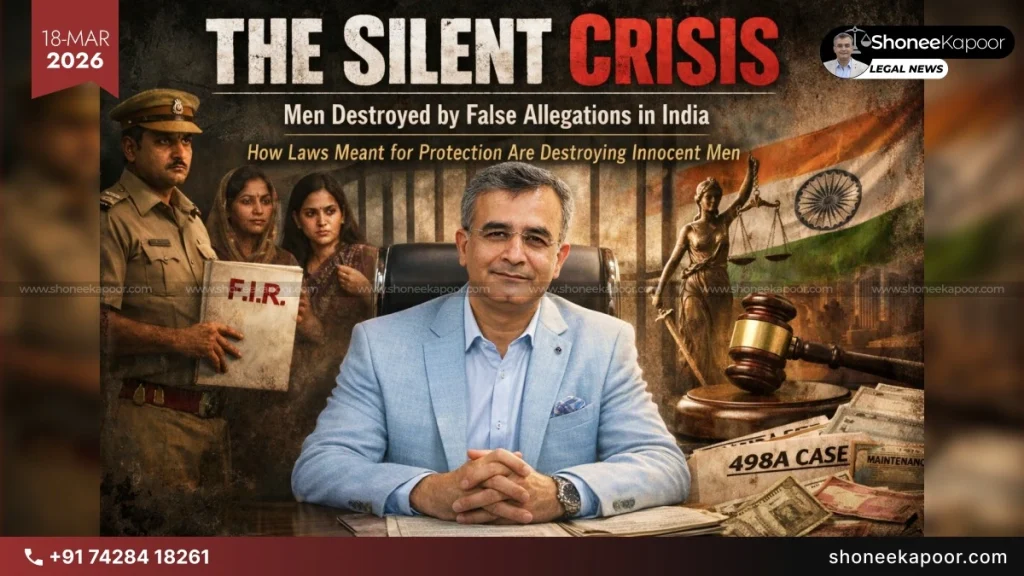
Laws Meant for Protection Are Destroying Innocent Men. An FIR is filed and a man’s life collapses before any evidence is tested.
This is not about rare misuse; it’s a growing legal reality every husband must understand before it’s too late.
NEW DELHI: Walk into any criminal court dealing with matrimonial disputes, and a pattern becomes immediately visible. A man often accompanied by ageing parents is not just fighting a legal case; he is fighting social stigma, financial ruin, and psychological collapse.
False allegations in matrimonial disputes are no longer isolated incidents. They have evolved into a structural issue within India’s criminal justice system—where arrest precedes investigation, and accusation alone carries the weight of guilt.
This is not a narrative built on emotion. It is grounded in judicial observations, statutory misuse patterns, and documented case law.
The Legal Framework: Where the Problem Begins
Several laws intended to protect women have, over time, become instruments of coercion when misused:
1. Section 498A IPC (Cruelty by Husband or Relatives)
- Cognizable and non-bailable
- Broad and vague definition of “cruelty”
- Enables immediate police intervention
2. Protection of Women from Domestic Violence Act, 2005
- Civil in nature but with quasi-criminal consequences
- Allows residence orders, protection orders, and monetary relief without strict evidentiary thresholds at interim stages
3. Section 125 CrPC (Maintenance)
- Financial pressure tool
- Often accompanied by inflated or unverifiable income claims
4. Dowry Prohibition Act, 1961
- Frequently invoked alongside 498A without independent scrutiny
Supreme Court Recognition of Misuse
The judiciary itself has repeatedly acknowledged that these provisions are being misused.
Arnesh Kumar v. State of Bihar (2014) 8 SCC 273
The Supreme Court issued strict directions against automatic arrests under Section 498A IPC:
- Police must satisfy necessity criteria under Section 41 CrPC
- Arrest should not be mechanical
- Magistrates must scrutinize arrest justification
Court Observation:
“Section 498A IPC is a cognizable and non-bailable offence and has lent itself to misuse… It is used as a weapon rather than a shield.”
Rajesh Sharma v. State of U.P. (2017) 8 SCC 746
The Court acknowledged large-scale misuse and recommended safeguards:
- Family Welfare Committees to scrutinize complaints before arrest (later modified)
Key Judicial Concern:
“In many cases, complaints are filed in the heat of the moment over trivial issues.”
Social Action Forum for Manav Adhikar v. Union of India (2018) 10 SCC 443
While modifying Rajesh Sharma guidelines, the Court still reaffirmed misuse concerns and emphasized cautious application.
Preeti Gupta v. State of Jharkhand (2010) 7 SCC 667
The Court made a strong observation:
“A serious relook of the entire provision is warranted… exaggerated versions of incidents are reflected in a large number of complaints.”
Ground Reality: How False Cases Operate
From a litigation standpoint, the pattern is consistent:
Stage 1: Breakdown of Marriage
- Marital discord escalates
- Negotiations fail
Stage 2: Legal Pressure Strategy
- FIR under Section 498A IPC
- Multiple relatives named (often including sisters, NRIs, elderly parents)
Stage 3: Parallel Proceedings
- Domestic Violence case
- Maintenance petition
- Possible allegations under Section 406 IPC (criminal breach of trust)
Stage 4: Coercive Settlement
- Arrest threat or actual arrest
- Passport seizure, job impact
- Pressure to settle monetarily
The Cost of a False Allegation
1. Immediate Criminalisation
A man becomes an “accused” overnight—without trial, without evidence tested.
2. Social Stigma
- Reputation damage is irreversible
- Professional consequences are severe, especially in corporate or government roles
3. Financial Drain
- Legal costs across multiple proceedings
- Interim maintenance orders based on assumed income
4. Psychological Impact
- Depression, anxiety, and documented cases of suicide
- Breakdown of family units
Judicial Reality: Acquittal Comes Too Late
In a significant number of cases, acquittals happen after years of trial.
But the system does not compensate:
- Loss of career
- Years of litigation
- Social damage
The process itself becomes the punishment.
The Problem of Arrest First, Investigation Later
Despite Arnesh Kumar, ground-level compliance remains inconsistent.
Police often:
- Register FIRs without preliminary verification
- Issue notices under Section 41A CrPC but still exert pressure
- Act under fear of departmental action if they appear “lenient”
Misuse Beyond 498A: Expanding Legal Pressure
False allegations are rarely isolated to one law.
A typical case may involve:
- 498A IPC
- 406 IPC
- Domestic Violence Act
- Maintenance under Section 125 CrPC
- False allegations of sexual misconduct in extreme cases
This creates a multi-front legal attack.
What Courts Are Quietly Indicating
Across High Courts, a pattern of judicial reasoning is emerging:
- Mechanical implication of relatives is being questioned
- Omnibus allegations without specific instances are being rejected
- Courts are increasingly granting anticipatory bail in weak cases
However, relief is reactive—not preventive.
The Core Structural Issues
1. Presumption of Guilt in Practice
Though law presumes innocence, enforcement assumes guilt.
2. Lack of Accountability for False Complaints
Perjury and false complaint provisions exist but are rarely invoked.
3. Gender-Specific Laws Without Safeguards
Absence of gender-neutral application creates imbalance.
4. No Compensation Mechanism
Acquitted individuals receive no restitution.
The Way Forward: Legal and Structural Reform
1. Strict Implementation of Arrest Guidelines
- Mandatory compliance audits of Arnesh Kumar
2. Penal Consequences for False Cases
- Active use of Section 182 IPC (false information)
- Section 211 IPC (false charge of offence)
3. Gender-Neutral Legal Framework
- Laws must address abuse, not gender
4. Pre-FIR Scrutiny Mechanism
- Neutral screening before registration in matrimonial disputes
5. Time-Bound Trials
- Fast-track courts for matrimonial criminal cases
Conclusion
The issue is not about denying protection to genuine victims. It is about recognising that a law without safeguards becomes a tool of abuse.
The silent crisis is this: men are being destroyed not by conviction, but by accusation.
Until the system distinguishes between protection and persecution, the imbalance will continue—and justice will remain selective.
FAQs
Yes. Courts routinely grant anticipatory bail where allegations are general, delayed, or lack specific instances.
Yes. High Courts quash proceedings against relatives when allegations are vague or omnibus.
You can pursue quashing under Section 482 CrPC and later initiate action under Sections 182 or 211 IPC.
No. As per Arnesh Kumar, arrest must satisfy necessity criteria.
Yes. Strategic use of anticipatory bail, quashing petitions, and evidence documentation is critical.