
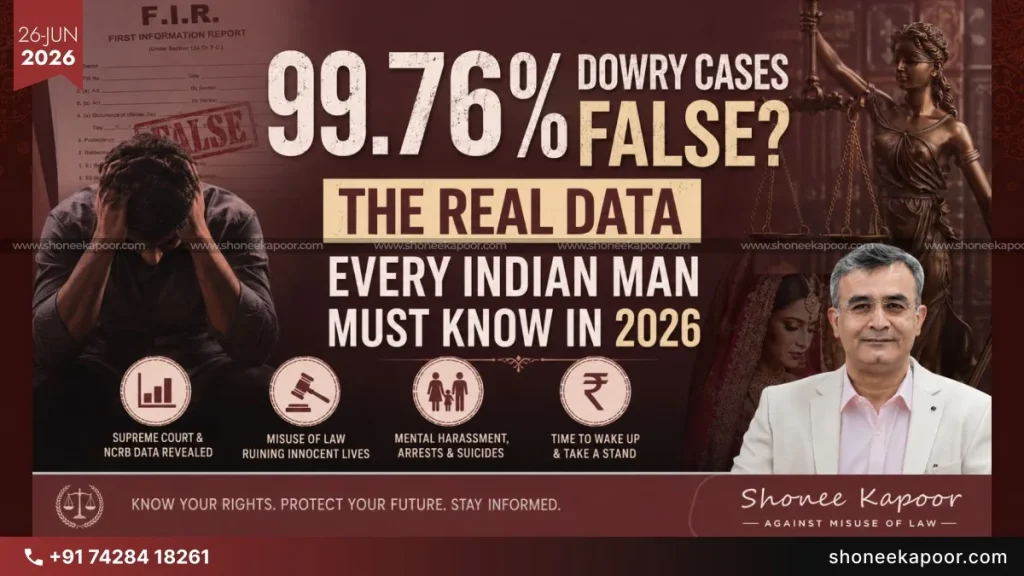
Is 99.76% of dowry cases in India false? Read real NCRB 2024 data, Delhi RTI findings, Supreme Court judgments, Section 85 BNS, 498A misuse and the legal truth.
NEW DELHI: India does not officially say that 99.76% dowry cases are false. But Delhi RTI data, NCRB 2024 numbers and repeated Supreme Court warnings show a brutal truth: thousands of men and families are dragged through criminal trials where conviction never comes.
IS 99.76% OF DOWRY CASES FILED AGAINST MEN FALSE?
This is the question men ask every day.
And the honest answer is this:
No official government report says 99.76% of all dowry cases are false.
But that does not mean the concern is fake.
It means the real data must be read correctly.
The 99.76% figure comes from a conviction-rate reading of a Delhi RTI-based dataset, where only 23 out of 9,950 Section 498A cases reportedly ended in conviction.
That means roughly 0.23% resulted in conviction and around 99.77% did not result in conviction in that dataset.
But legally, “not convicted” is not automatically equal to “false.”
An acquittal may happen because evidence was weak.
A case may be quashed because allegations were vague.
A case may end in compromise.
A case may fail because prosecution could not prove guilt beyond reasonable doubt.
A case may also be false.
But Indian crime statistics do not put all these outcomes into one box called “false case.”
That is why any serious legal discussion must be sharp, not careless.
The correct headline is not merely:
99.76% DOWRY CASES ARE FALSE.
The correct legal headline is:
99.76% Of Cases In One Delhi 498A Dataset Did Not End In Conviction — And That Exposes A Massive Justice Problem For Men.
That is the real issue.
And that issue cannot be dismissed.
WHAT THE DELHI RTI DATA SHOWS
As per the reported Delhi district court RTI data for 2021–2024:
| DATA POINT | FIGURE |
| Section 498A cases examined | 9,950 |
| Convictions | 23 |
| Conviction rate | Around 0.23% |
| Cases not ending in conviction | Around 99.77% |
| Cases quashed by Delhi High Court | 4,655 |
| Acquittals | 736 |
This is not a small number.
This is not a minor technicality.
This is the life of an accused man.
This is the life of his parents.
This is the life of his married sister, unmarried sister, old mother, retired father and sometimes even relatives living in different cities.
When a man is falsely or weakly implicated in a dowry-cruelty case, the punishment begins on day one.
Not after conviction.
- The punishment starts with FIR.
- The punishment starts with police notice.
- The punishment starts with anticipatory bail.
- The punishment starts with relatives being named.
- The punishment starts with career damage.
- The punishment starts with social humiliation.
- The punishment starts with settlement pressure.
That is why a low conviction rate in 498A-type cases is not just a statistic.
It is a constitutional warning.
WHAT NCRB 2024 SAYS ABOUT CRUELTY BY HUSBAND OR RELATIVES
The latest NCRB Crime in India 2024 data records “Cruelty by Husband or his Relatives” under the new BNS framework.
In 2024, NCRB recorded:
| NCRB 2024 CATEGORY | FIGURE |
| New cases reported under Cruelty by Husband or Relatives | 1,20,227 |
| Cases ended as final report false | 4,593 |
| Cases ended as mistake of fact/law or civil dispute | 3,459 |
| Cases charge-sheeted | 1,08,574 |
| Cases pending investigation at year end | 45,011 |
| Court conviction rate | 20.1% |
| Cases pending trial at year end | 8,54,798 |
| Trial pendency percentage | 92.2% |
This data does not say 99.76% cases are false.
But it says something equally serious.
It says lakhs of people remain trapped in trial.
It says conviction is low.
It says pendency is massive.
It says many cases are officially closed as false, mistake of fact/law, civil dispute, insufficient evidence, untraced or no clue.
And it says the system has no clean mechanism to separate genuine victims from malicious litigants quickly.
That is the disease.
The man suffers before the court decides.
The family suffers before evidence is tested.
The process itself becomes punishment.
WHAT NCRB 2024 SAYS ABOUT DOWRY PROHIBITION ACT CASES
The Dowry Prohibition Act, 1961 is a separate law. It punishes giving, taking, abetting and demanding dowry.
In 2024, NCRB recorded:
| NCRB 2024 DOWRY PROHIBITION ACT DATA | FIGURE |
| New cases reported | 12,343 |
| Cases ended as final report false | 462 |
| Cases ended as mistake of fact/law or civil dispute | 386 |
| Cases charge-sheeted | 10,781 |
| Court conviction rate | 17.4% |
| Cases pending trial at year end | 83,298 |
| Trial pendency percentage | 94.6% |
Again, this does not prove 99.76% false.
But it proves that the criminal justice system is clogged with cases where conviction is far from automatic and trials take years.
For a genuine victim, delay destroys justice.
For an innocent man, delay itself is injustice.
Both realities can exist together.
UPDATED INDIAN LAW IN 2026: 498A IS NOW SECTION 85 BNS
After the new criminal laws came into force, old Section 498A IPC is now substantially reflected in Section 85 of the Bharatiya Nyaya Sanhita, 2023.
Section 85 BNS
This punishes the husband or relative of the husband of a woman for subjecting her to cruelty.
Punishment: imprisonment up to three years and fine.
Section 86 BNS
This defines cruelty as:
- wilful conduct likely to drive the woman to suicide or cause grave injury or danger to life, limb or health, mental or physical; or
- harassment with a view to coercing her or her relatives to meet unlawful demand for property or valuable security, or harassment because such demand was not met.
This is important:
- Every matrimonial fight is not Section 85 BNS.
- Every bad marriage is not dowry cruelty.
- Every argument is not criminal cruelty.
- Every failed relationship is not a jail-worthy offence.
- Criminal law requires ingredients.
- Criminal law requires evidence.
- Criminal law requires specific allegations.
- Criminal law cannot run on emotion alone.
DOWRY DEATH LAW: SECTION 80 BNS
Section 80 BNS deals with dowry death.
Broadly, dowry death applies where:
- the death of a woman is caused by burns, bodily injury or otherwise than under normal circumstances;
- death occurs within seven years of marriage;
- soon before death, she was subjected to cruelty or harassment; and
- such cruelty or harassment was for, or in connection with, demand for dowry.
Punishment may extend from seven years to life imprisonment.
This is a serious offence.
Genuine dowry death cases must be prosecuted strongly.
But the seriousness of genuine cases cannot be used as a licence to falsely implicate innocent men and their families in ordinary matrimonial disputes.
Justice cannot be selective.
Justice cannot say “protect women” and forget “protect innocent men.”
DOWRY PROHIBITION ACT, 1961: SECTIONS MEN MUST KNOW
Section 3
Punishes giving, taking or abetting the giving or taking of dowry.
Section 4
Punishes demanding dowry directly or indirectly.
Section 8A
In prosecutions under Section 3 or Section 4, the burden of proving that the accused did not commit the offence is placed on the accused.
That is why dowry-law litigation is not casual.
Once a man and his family are dragged into such cases, the legal, financial and social cost is severe.
The law is powerful.
Therefore, its misuse is also powerful.
SUPREME COURT ON 498A MISUSE: WHAT COURTS HAVE ACTUALLY SAID
Indian courts have never said genuine victims should stay silent.
But courts have repeatedly warned that matrimonial criminal law is being misused in many cases.
1. Sushil Kumar Sharma v Union of India
The Supreme Court upheld the validity of Section 498A.
But it also warned that misuse of the provision could become “legal terrorism.”
The message was clear.
A law made for protection cannot become a weapon of harassment.
2. Arnesh Kumar v State of Bihar
The Supreme Court directed that police should not automatically arrest in Section 498A cases.
This judgment changed the landscape of arrest in matrimonial offences.
Why?
Because arrest itself was being used as pressure.
A man could be innocent, but once arrested, his reputation, job and family life were damaged before trial even started.
3. Preeti Gupta v State of Jharkhand
The Supreme Court observed that matrimonial litigation was rapidly increasing and courts must be careful and cautious in dealing with complaints where relatives of the husband are roped in.
This matters because false implication is rarely limited to the husband.
The full family becomes accused.
Old parents.
Married sisters.
Brothers.
Sometimes relatives who never lived with the couple.
This is not prosecution.
This becomes family-wide punishment.
4. Kahkashan Kausar v State of Bihar
The Supreme Court warned against general and omnibus allegations in matrimonial disputes.
The Court recognised that when every relative is named without specific role, it can become abuse of process.
This is one of the strongest safeguards for innocent in-laws.
5. Dara Lakshmi Narayana v State of Telangana
The Supreme Court again dealt with general allegations in matrimonial litigation and repeated the need to prevent abuse of process where vague allegations are used to implicate relatives.
The Court did not destroy the law.
The Court protected the law from misuse.
That is the difference.
WHY “FALSE CASE” IS LEGALLY DIFFICULT TO COUNT
People often ask:
If a man is acquitted, was the case false?
Legally, not always.
An acquittal means the prosecution failed to prove guilt beyond reasonable doubt.
A quashing order may mean allegations did not disclose the offence.
A closure report may say the case was false.
A final report may say it was mistake of fact or law.
A compromise may end the litigation without deciding truth.
A discharge may happen because there is no sufficient ground to proceed.
All these are different legal outcomes.
But for the accused man, the damage often looks the same.
- Years lost.
- Money lost.
- Reputation lost.
- Mental peace lost.
- Parents dragged.
- Career affected.
- Marriage destroyed.
That is why the debate should not be reduced to one slogan.
The real question is bigger:
How many men and families are being forced to face criminal prosecution where guilt is never proved?
That question India must answer.
THE MEN’S RIGHTS POSITION
Let me be very clear.
- Genuine dowry harassment must be punished.
- Genuine cruelty must be punished.
- Genuine dowry death must be punished.
- But false cases must also be punished.
- The law cannot be blind in only one direction.
- A woman who suffers cruelty deserves justice.
- A man falsely accused also deserves justice.
- A mother falsely named also deserves justice.
- A father dragged to court in old age also deserves justice.
- A married sister implicated only to create settlement pressure also deserves justice.
- The Constitution does not say dignity belongs to one gender.
- Article 21 protects life and personal liberty.
- That liberty includes reputation.
- That liberty includes mental peace.
- That liberty includes freedom from malicious prosecution.
WHY LOW CONVICTION IN 498A MATTERS
Some people say low conviction does not prove false cases.
That is legally correct.
But low conviction still proves a system problem.
- If cases are genuine, why are convictions so low?
- If investigations are poor, why are men arrested and families harassed before proper evidence is collected?
- If cases are weak, why are they allowed to continue for years?
- If allegations are vague, why are old parents and distant relatives forced into trial?
- If settlements are the real endgame, why is criminal law being used as negotiation machinery?
These are not anti-women questions.
These are pro-justice questions.
And justice cannot be gender-selective.
THE BRUTAL TRUTH
The 99.76% number should not be blindly sold as “official false-case data.”
That would be legally weak.
But the number exposes something India cannot ignore.
In the Delhi RTI dataset, only 23 out of 9,950 cases ended in conviction.
That means thousands of accused persons were dragged through litigation without conviction.
Some were acquitted.
Many were quashed.
Many suffered for years.
And the system still has no serious accountability for false or malicious complaints.
This is the real men’s rights issue.
Not slogans.
Not outrage.
Data.
Court orders.
Human cost.
WHAT REFORM IS NEEDED?
1. Make False Complaints Punishable In Practice
Existing law has provisions for perjury and false prosecution, but they are rarely used in matrimonial cases.
2. Mandatory Specific Allegation Test
No relative should be summoned or charge-sheeted without specific role, date, act and evidence.
3. Time-Bound 498A Trials
A man should not spend 7 to 12 years proving what should have been tested in 12 months.
4. Virtual Investigation And Trial
For relatives living in different cities, virtual participation should become the norm unless physical presence is necessary.
5. Settlement Pressure Must Stop
Criminal law should not become a recovery counter.
6. Arrest Must Remain Exception, Not Routine
Arnesh Kumar safeguards must be followed strictly.
7. Gender-Neutral Discussion On Misuse
Protect genuine victims.
Punish genuine offenders.
But do not sacrifice innocent men to preserve a false public narrative.
FINAL WORD
So, are 99.76% dowry cases false?
Officially, no such national figure exists.
But does the justice system show massive failure, misuse concern, low conviction, huge pendency and devastating impact on men?
Yes.
Absolutely yes.
India must stop pretending that every matrimonial FIR is gospel truth.
India must also stop pretending that every accused man is guilty until acquitted.
A false case does not merely attack one man.
- It attacks his family.
- It attacks his dignity.
- It attacks his years.
- It attacks his parents.
- It attacks the meaning of justice itself.
Justice must protect genuine victims.
But justice must also protect falsely accused men.
Anything less is not justice.
It is gendered punishment.
FAQs
No. India has no official national data saying 99.76% dowry cases are false. The figure comes from a Delhi 498A conviction-rate dataset, not an official false-case declaration.
It means that in one reported Delhi RTI dataset, only 23 out of 9,950 cases ended in conviction, so around 99.77% did not end in conviction.
Not always. Acquittal means guilt was not proved beyond reasonable doubt. A case is “false” only when legally or factually found to be false.
Section 498A IPC is now substantially covered under Section 85 of the Bharatiya Nyaya Sanhita, 2023. Cruelty is defined separately under Section 86 BNS.
Yes. The Supreme Court has repeatedly warned against misuse, automatic arrest, vague allegations and roping in husband’s relatives without specific material.