
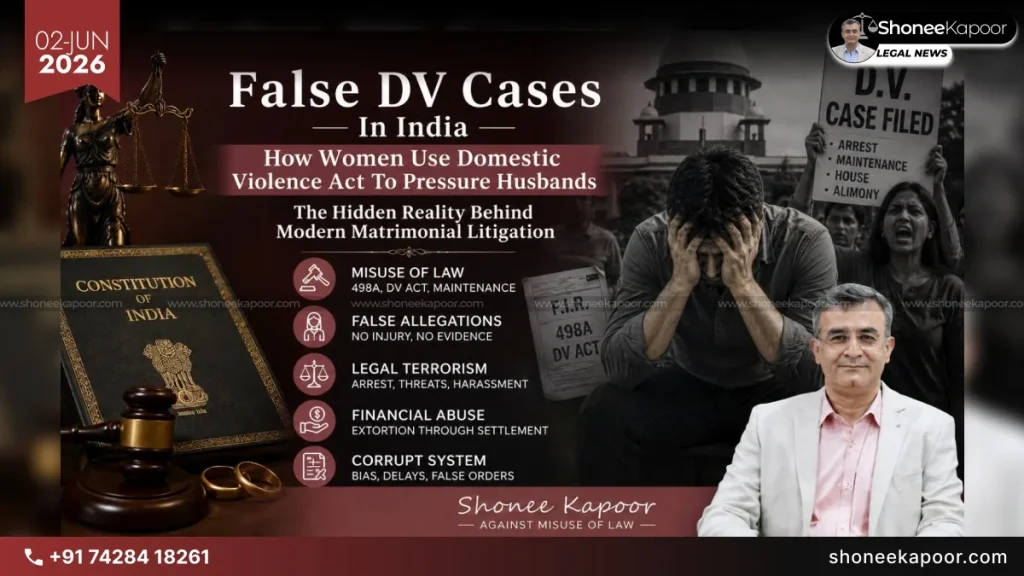
False DV Act cases in India are often used to pressure husbands for money, property, residence and settlement. Know the law, case laws, rights and strategy.
NEW DELHI: A law made to protect genuine victims should never become a weapon to destroy innocent husbands and their families.
The Protection of Women from Domestic Violence Act, 2005 was enacted to give quick civil relief to women facing domestic violence inside the family. It covers physical abuse, sexual abuse, verbal and emotional abuse, and economic abuse. It gives remedies like protection orders, residence orders, monetary relief, custody orders, compensation and interim orders.
But in many matrimonial disputes, the DV Act is no longer used only as a shield. It is used as pressure.
- Pressure for settlement.
- Pressure for money.
- Pressure for property.
- Pressure to keep the husband and his old parents trapped in court for years.
This is the bitter courtroom reality which thousands of husbands face in India.
WHAT IS THE DV ACT ACTUALLY MEANT FOR?
The DV Act is a welfare law. Its object is to protect women who are victims of domestic violence occurring within a domestic relationship.
Under Section 3, domestic violence includes physical, sexual, verbal, emotional and economic abuse. Under Section 12, an aggrieved woman can approach the Magistrate. Under Sections 18 to 23, the court can pass protection, residence, monetary, custody, compensation and interim orders.
The Supreme Court has also held that DV proceedings are predominantly civil in nature, though they are filed before a Magistrate.
This means one thing very clearly:
- The DV Act is not meant to punish every husband first and verify facts later.
- It is meant to provide genuine protection after judicial scrutiny.
HOW DV ACT IS USED TO PRESSURE HUSBANDS
In real matrimonial litigation, a DV case is often filed along with 498A, maintenance, divorce, child custody and property claims.
The husband suddenly faces multiple cases in different courts. His parents are added. His sisters are added. Sometimes even relatives who never lived with the wife are made parties.
The purpose is simple: make litigation so exhausting that the husband agrees to any settlement.
A false DV case usually creates pressure in five ways.
1. By Making General Allegations Against The Whole Family
Many complaints do not give clear dates, clear incidents or clear roles. They simply say that the husband, mother-in-law, father-in-law, sisters-in-law and other relatives harassed the woman.
This is where the misuse begins.
A person who never lived in the shared household cannot be dragged merely because he or she is related to the husband. Courts have repeatedly criticised omnibus allegations in matrimonial litigation.
In February 2025, the Allahabad High Court observed that relatives who are not even living in the shared household are often implicated in DV Act cases to harass the husband’s family.
This is not justice.
This is litigation by dragnet.
2. By Using Residence Rights As Property Pressure
Section 17 gives a woman the right to reside in the shared household. Section 19 allows residence orders.
But this right is often converted into a property weapon.
In many cases, the wife claims residence in the husband’s parental house even when the property belongs to old parents. The fight then shifts from matrimonial protection to property control.
The Supreme Court in Satish Chander Ahuja v. Sneha Ahuja gave a broad interpretation to “shared household.” But that does not mean that every daughter-in-law gets ownership rights in the in-laws’ property. Residence right is not title. Residence right is not ownership. Residence right is not a licence to capture property.
This distinction must be understood.
3. By Claiming Monetary Relief Without Full Financial Disclosure
Section 20 allows monetary relief. It can include loss of earnings, medical expenses, maintenance and loss caused due to destruction or removal of property.
But in many cases, income is hidden.
The wife may suppress her job, bank accounts, rental income, business income, lifestyle, foreign stay or family support. The husband is then projected as the only earning person, and inflated maintenance is demanded.
This is why the Supreme Court in Rajnesh v. Neha directed disclosure of assets and liabilities in maintenance proceedings. The idea was simple: maintenance cannot be decided on emotional allegations alone. It must be decided on financial truth.
A husband must not fight maintenance blindly. He must collect income proof, social media lifestyle proof, travel proof, bank clues, employment details and contradictions in affidavits.
4. By Taking Ex Parte Interim Orders
Section 23 allows interim and ex parte orders.
This provision is necessary in genuine urgent cases. But in false cases, it becomes a shock weapon.
A husband may suddenly receive an order for residence, maintenance or restraint without proper opportunity to place his full defence. Then the litigation becomes about compliance, arrears, execution and fear.
The husband starts fighting from a defensive position.
This is why documentation from day one is critical.
Messages, call recordings where legal threats are made, settlement chats, proof of separate residence, rent records, medical documents, income records and travel history can become decisive.
5. By Keeping The Case Pending For Years
A false DV case is not always filed to win. Sometimes it is filed to keep the husband under pressure.
Dates keep coming.
Evidence does not move.
Cross-examination is delayed.
The wife remains absent.
But the husband has to appear, spend money, and live under the shadow of litigation.
In September 2025, a Delhi court dismissed a domestic violence case after the woman remained absent for years and observed that the DV Act cannot be used to harass a spouse. This is exactly what many husbands face: litigation as punishment.
IMPORTANT SUPREME COURT CASE LAW FOR HUSBANDS FACING DV CASES
Shaurabh Kumar Tripathi v. Vidhi Rawal, Supreme Court, 2025
The Supreme Court held that High Courts can use Section 482 CrPC or Section 528 BNSS to quash proceedings arising from a Section 12 DV Act application.
But the Court also warned that this power must be used cautiously because the DV Act is welfare legislation.
Meaning: false DV cases can be challenged, but only where there is gross illegality, gross abuse of process or clear injustice.
Hiral P. Harsora v. Kusum Narottamdas Harsora, Supreme Court, 2016
The Supreme Court struck down the words “adult male” from the definition of respondent under Section 2(q). After this, even women can be respondents in DV Act proceedings.
This means a mother-in-law can also file a DV case against a daughter-in-law if the legal ingredients are satisfied.
Satish Chander Ahuja v. Sneha Ahuja, Supreme Court, 2020
The Supreme Court expanded the meaning of shared household and held that the earlier narrow view in S.R. Batra was not correct.
But the judgment does not give ownership rights to the wife in the in-laws’ property. It deals with residence, not title.
Rajnesh v. Neha, Supreme Court, 2020
The Supreme Court issued guidelines to streamline maintenance cases and directed disclosure of assets and liabilities.
This judgment is crucial when monetary relief is claimed under the DV Act.
Kunapareddy v. Kunapareddy Swarna Kumari, Supreme Court, 2016
The Supreme Court recognised that DV Act proceedings are predominantly civil in nature and are meant to provide civil remedies to women.
This helps husbands understand that a DV case is not the same as a criminal conviction.
WHAT SHOULD A HUSBAND DO IMMEDIATELY AFTER A DV CASE?
- First, stop emotional reactions.
- Second, start documentation.
- Third, do not send abusive messages.
- Fourth, do not threaten settlement.
- Fifth, do not ignore court notices.
- Sixth, file a detailed reply with documents.
- Seventh, challenge vague allegations.
- Eighth, expose contradictions.
- Ninth, file income documents properly.
- Tenth, use appeal, revision or quashing remedy where legally maintainable.
A husband loses many cases not because the wife has truth, but because he has no documents.
Court does not run on pain.
Court runs on pleadings, evidence and strategy.
COMMON DEFENCE POINTS IN FALSE DV CASES
A husband can contest the case on multiple legal and factual grounds:
- There was no domestic relationship with some respondents.
- Certain relatives never lived in the shared household.
- Allegations are vague, general and without dates.
- The wife is already living separately for years.
- There is no recent act of domestic violence.
- The wife has independent income.
- The wife has suppressed material facts.
- Parallel maintenance is already granted.
- Property claimed is not owned by the husband.
- The complaint is filed only after divorce, settlement talks or another litigation.
- Each case depends on facts. But one rule is universal: never fight a DV case casually.
THE HARD TRUTH ABOUT DV ACT MISUSE
- Every woman is not lying.
- Every man is not innocent.
- But every husband is also not guilty merely because a complaint has been filed.
- The DV Act was made for protection, not extortion.
- It was made for genuine victims, not legal blackmail.
- It was made to stop violence, not to create a litigation industry where husbands, parents and families are forced to buy peace.
- A false DV case does not only damage a man financially. It attacks his reputation, mental health, parents, career, children and future.
- That is why men must stop begging for sympathy and start fighting with evidence.
CONCLUSION
The Domestic Violence Act is a powerful law. In genuine cases, it protects women. In false cases, it becomes a pressure machine against husbands.
The solution is not to weaken protection for genuine victims.
The solution is to punish misuse, demand strict scrutiny, insist on specific allegations, protect elderly parents, stop property pressure, and make false litigants accountable.
Justice cannot be gender-blind only when men suffer.
Justice must protect victims.
But justice must also protect innocent husbands from false cases.
FAQs
Yes. The Supreme Court has held that High Courts can quash DV Act proceedings under Section 482 CrPC or Section 528 BNSS in cases of gross illegality, abuse of process or clear injustice.
Yes, but only if legal ingredients exist. Relatives cannot be dragged only because they are related to the husband. Specific allegations and domestic relationship are important.
No. DV Act may give residence protection in a shared household, but it does not give ownership or title in the property.
Yes. Section 20 allows monetary relief. But income, needs, liabilities and existing maintenance orders must be considered.
Do not panic. Preserve evidence, avoid abusive communication, collect financial documents, prepare a detailed reply and consult a matrimonial litigation expert immediately.