
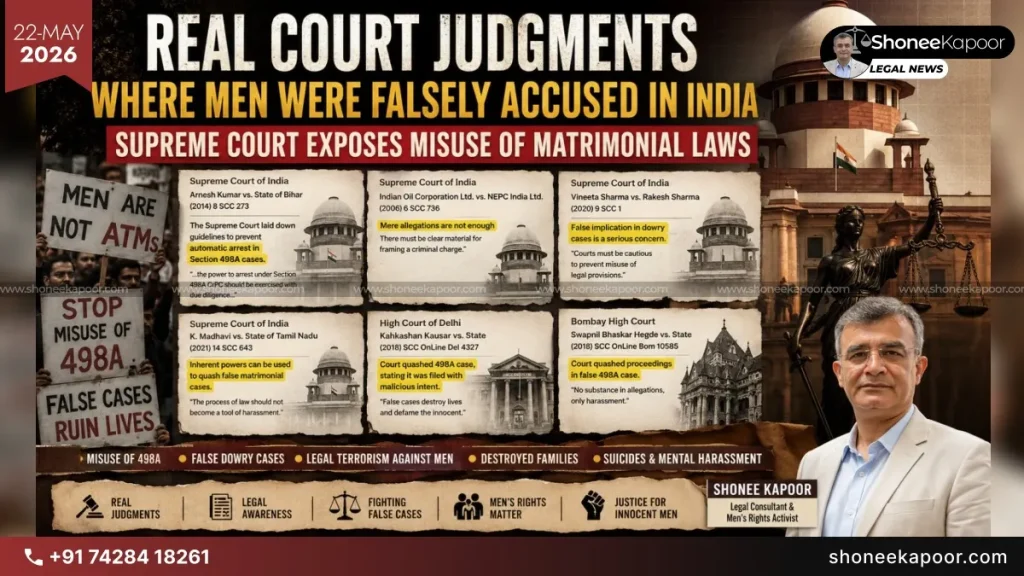
Real Indian court judgments with correct case titles and citations where courts protected men and families from false or exaggerated matrimonial and criminal allegations.
NEW DELHI: False accusations are not “rare exceptions” anymore. Indian courts themselves have repeatedly acknowledged the misuse of criminal law in matrimonial and relationship disputes.
The Supreme Court has repeatedly warned against vague allegations, omnibus FIRs, indiscriminate implication of relatives, and criminal prosecution being used as a pressure tactic in matrimonial warfare.
This article contains only real Indian judgments, correct case titles, and legally accurate references.
1. Arnesh Kumar v. State of Bihar & Anr.
Citation: (2014) 8 SCC 273
Court: Supreme Court of India
What Happened
A husband facing allegations under Section 498A IPC challenged the routine arrest mechanism being followed by police.
The Supreme Court noticed that arrests in matrimonial disputes had become mechanical and abusive.
What The Supreme Court Said
The Court held that arrest is not automatic merely because a 498A FIR is registered.
Police officers must satisfy the conditions under Section 41 CrPC before arresting the accused.
Landmark Observation
The Court specifically warned against misuse of Section 498A and observed that the provision had become a weapon rather than a shield in several cases.
Why This Judgment Matters
This remains the most important protection against automatic arrest in matrimonial cases.
2. Rajesh Sharma & Ors. v. State of U.P. & Anr.
Citation: (2018) 10 SCC 472
Court: Supreme Court of India
What Happened
The Supreme Court examined growing misuse of Section 498A IPC and false implication of husbands and relatives.
What The Supreme Court Said
The Court acknowledged:
“There is a growing tendency to rope in all family members of the husband.”
The Court also discussed how criminal complaints were being used as settlement pressure.
Why This Judgment Matters
This judgment became one of the strongest judicial acknowledgments of misuse of matrimonial laws.
3. Social Action Forum for Manav Adhikar v. Union of India
Citation: (2018) 10 SCC 443
Court: Supreme Court of India
What Happened
Certain directions issued in Rajesh Sharma were challenged.
What The Supreme Court Said
The Court protected genuine victims while still recognising misuse concerns.
The Court clarified that safeguards against arbitrary arrests must continue.
Why This Judgment Matters
The judgment balanced women’s protection with due process rights for accused husbands and families.
4. Kahkashan Kausar @ Sonam & Ors. v. State of Bihar & Ors.
Citation: (2022) 6 SCC 599
Court: Supreme Court of India
What Happened
A wife implicated multiple relatives of the husband with broad and vague allegations.
What The Supreme Court Said
The Supreme Court quashed proceedings against relatives and held:
“False implication by way of general omnibus allegations made in the course of matrimonial dispute, if left unchecked, would result in misuse of the process of law.”
Why This Judgment Matters
This judgment is now routinely cited in quashing petitions involving false implication of in-laws.
5. Dara Lakshmi Narayana & Ors. v. State of Telangana & Anr.
Citation: 2024 INSC 1006
Date: 10 December 2024
Court: Supreme Court of India
What Happened
The Supreme Court examined allegations under Section 498A IPC against the husband’s family.
What The Supreme Court Said
The Court warned that matrimonial cases increasingly involve exaggerated and sweeping allegations against the husband’s relatives.
The Court reiterated that criminal prosecution cannot continue without specific allegations and credible material.
Why This Judgment Matters
This is one of the latest Supreme Court judgments directly acknowledging misuse concerns under matrimonial criminal law.
6. K. Subba Rao v. State of Telangana
Citation: (2018) 14 SCC 452
Court: Supreme Court of India
What Happened
Relatives of the husband were implicated in a matrimonial prosecution without clear evidence.
What The Supreme Court Said
The Supreme Court held:
“The Courts should be careful in proceeding against distant relatives in crimes pertaining to matrimonial disputes.”
Why This Judgment Matters
The judgment protects elderly parents and distant relatives from mechanical prosecution.
7. Preeti Gupta & Anr. v. State of Jharkhand & Anr.
Citation: (2010) 7 SCC 667
Court: Supreme Court of India
What Happened
The Court examined misuse patterns in Section 498A prosecutions.
What The Supreme Court Said
The Court observed:
“A serious relook of the entire provision is warranted by the Legislature.”
The Court also noted exaggerated versions of incidents in matrimonial complaints.
Why This Judgment Matters
This remains one of the strongest judicial criticisms of misuse of 498A IPC.
8. Sushil Kumar Sharma v. Union of India
Citation: (2005) 6 SCC 281
Court: Supreme Court of India
What Happened
The constitutional validity of Section 498A IPC was challenged due to misuse concerns.
What The Supreme Court Said
The Supreme Court upheld the provision but clearly acknowledged misuse.
Landmark Observation
“Merely because the provision is constitutional and intra vires, does not give a licence to unscrupulous persons to wreck personal vendetta.”
Why This Judgment Matters
This was among the earliest Supreme Court warnings regarding false matrimonial prosecutions.
9. Jaspal Singh Kaural v. State (NCT of Delhi)
Citation: 2025 SCC OnLine SC ___ (Decision dated 21 January 2025)
Court: Supreme Court of India
What Happened
The accused faced rape allegations based on an alleged false promise of marriage.
What The Supreme Court Said
The Supreme Court reiterated:
“A promise to marry will not amount to rape in every case.”
The Court clarified that prosecution must prove the promise was false from the beginning.
Source Supreme Court order dated 21 January 2025.
Why This Judgment Matters
The judgment protects against criminalisation of every failed relationship.
10. Dr. Sagar Das & Ors. v. State of West Bengal & Anr.
Citation: 2024 SCC OnLine Cal 4253
Court: Calcutta High Court
What Happened
The husband’s relatives were implicated through broad allegations.
What The Court Said
The Court reiterated that relatives cannot be roped in merely through omnibus allegations without specific incidents.
Source Indian Kanoon judgment extract.
THE GROUND REALITY COURTS ARE NOW RECOGNISING
Indian courts are increasingly acknowledging three dangerous trends:
- Entire families being named without evidence
- Criminal law being used as leverage in matrimonial settlements
- False or exaggerated allegations causing irreversible damage before trial even begins
The law exists to punish cruelty.
But the law cannot become cruelty itself.
A false criminal case does not merely attack one man. It attacks elderly parents, careers, mental health, finances, children, and constitutional liberty.
The courtroom eventually restores innocence.
But for many men, the punishment begins long before the judgment.
FAQs
No. After Arnesh Kumar v. State of Bihar, arrest is not automatic.
Yes. High Courts regularly quash vague and omnibus FIRs.
No. Courts repeatedly hold that specific allegations are necessary.
No. Courts require proof that the promise was false from the very beginning.
Yes. Multiple Supreme Court judgments have expressly acknowledged misuse concerns.