
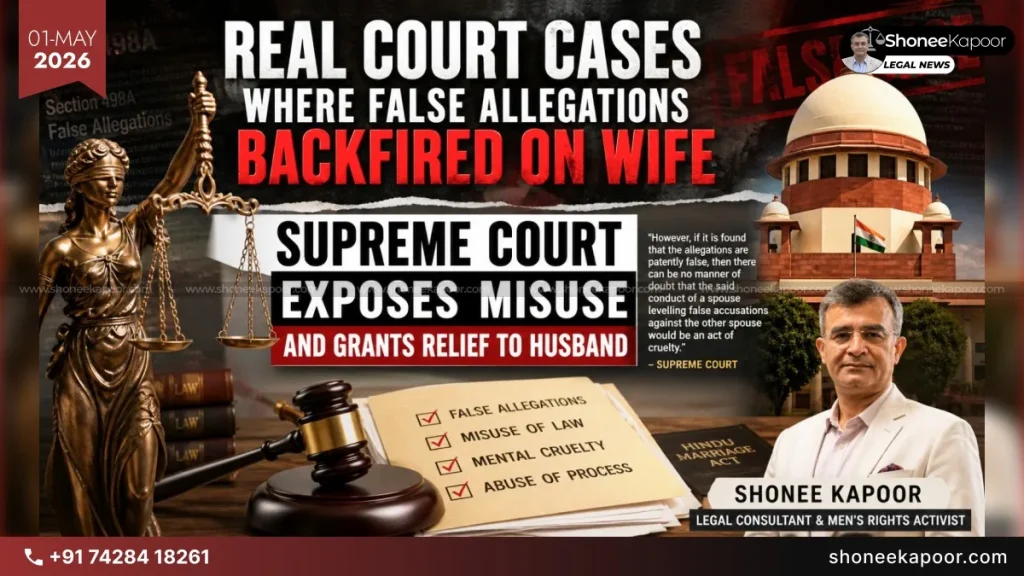
Real Indian court cases where false 498A, dowry, cruelty and defamatory allegations against husbands backfired, leading to divorce, quashing, costs and findings of mental cruelty.
NEW DELHI: False cases do not merely create litigation. They destroy reputations, careers, families, liberty and mental peace. For years, men have been told to “adjust”, “settle” or “pay and move on”. But Indian courts have repeatedly made one thing clear: when allegations are found to be false, reckless, defamatory or used as a weapon, they can legally backfire.
This is not about denying genuine cruelty. Genuine victims deserve protection. But false allegations are not women’s empowerment. They are legal abuse.
Under Indian matrimonial law, especially Section 13(1)(i-a) of the Hindu Marriage Act, 1955, cruelty is a valid ground for divorce. Indian courts have held that false criminal complaints, false allegations of dowry demand, false allegations against character, and repeated malicious litigation can amount to mental cruelty.
After the new criminal laws came into force, cruelty by husband or relatives is now dealt with under Section 85 of the Bharatiya Nyaya Sanhita, 2023, with cruelty defined under Section 86 BNS; older cases continue to refer to Section 498A IPC because those prosecutions arose under the earlier IPC regime. The Bharatiya Sakshya Adhiniyam, 2023 also carries forward presumptions in matrimonial offences, including dowry death presumptions under Section 118.
1. K. Srinivas Rao v. D.A. Deepa: False 498A And Job Complaints Became Mental Cruelty
In K. Srinivas Rao v. D.A. Deepa, the Supreme Court dealt with a marriage where the wife had made serious allegations and pursued multiple proceedings against the husband and his family.
The Family Court had found that the dowry demand story was false and that filing a false Section 498A complaint and complaints affecting the husband’s employment caused mental cruelty. The Supreme Court noted that repeated false complaints and defamatory allegations can amount to cruelty.
The Court clearly held:
“Making unfounded indecent defamatory allegations against the spouse or his or her relatives in the pleadings, filing of complaints or issuing notices or news items which may have adverse impact on the business prospect or the job of the spouse and filing repeated false complaints and cases in the court against the spouse would, in the facts of a case, amount to causing mental cruelty to the other spouse.”
The Supreme Court also said staying together is not necessary for cruelty to happen. A spouse can cause mental cruelty even while living separately by filing cases and making defamatory allegations. The marriage was dissolved and divorce was granted to the husband.
Backfire: False allegations and repeated complaints helped the husband get divorce on cruelty.
2. Raj Talreja v. Kavita Talreja: Self-Inflicted Injury Allegation Backfired
In Raj Talreja v. Kavita Talreja, the Supreme Court dealt with reckless and defamatory allegations made by the wife against the husband, his family members and colleagues.
The Court drew an important distinction: merely filing a complaint is not cruelty if there is a genuine reason. But if allegations are patently false, then they become cruelty.
The Supreme Court held:
“Mere filing of complaints is not cruelty, if there are justifiable reasons to file the complaints.”
But the Court immediately added:
“However, if it is found that the allegations are patently false, then there can be no manner of doubt that the said conduct of a spouse levelling false accusations against the other spouse would be an act of cruelty.”
In that case, police found that one complaint was false and that injuries were self-inflicted. Proceedings were launched under Section 182 IPC.
Backfire: False accusations became mental cruelty and supported divorce.
3. Rani Narasimha Sastry v. Rani Suneela Rani: Acquittal In 498A Became Ground For Divorce
In Rani Narasimha Sastry v. Rani Suneela Rani, the wife had filed a criminal case under Section 498A IPC. The husband faced trial and was eventually acquitted because the prosecution failed to prove the charge.
The Supreme Court held that mere filing of an FIR cannot automatically be called cruelty. But where the husband undergoes a criminal trial and is acquitted, the court cannot ignore the cruelty caused to him.
The Court held:
“But when a person undergoes a trial in which he is acquitted of the allegation of offence under Section 498-A of IPC, levelled by the wife against the husband, it cannot be accepted that no cruelty has meted on the husband.”
The husband was granted divorce.
Backfire: The failed 498A prosecution became a major ground for divorce in favour of the husband.
4. Vishwanath Agrawal v. Sarla Vishwanath Agrawal: False Character Allegations Became Cruelty
In Vishwanath Agrawal v. Sarla Vishwanath Agrawal, the wife alleged that the husband had an illicit relationship. The Supreme Court examined whether such an allegation was proven by acceptable evidence.
The Court noted that the wife had also filed a complaint under Section 494 IPC, but the husband was discharged and that order was not challenged.
The larger principle is clear: allegations of adultery, womanising or immoral conduct cannot be thrown casually in pleadings or public spaces. If not proved, they can cause serious mental agony and amount to cruelty.
Backfire: Unsupported allegations against the husband’s character strengthened the case for mental cruelty.
5. Parteek Bansal v. State of Rajasthan: Supreme Court Quashed FIR And Imposed Rs. 5 Lakh Cost
In Parteek Bansal v. State of Rajasthan, the Supreme Court dealt with multiple complaints on similar allegations against the husband. The case involved FIRs under Sections 498A, 406, 384, 420 and 120B IPC.
The Supreme Court found that the proceedings were an abuse of process. It noted that the complainant side had allowed proceedings to continue in Hisar and then initiated another complaint at Udaipur. The Court said their only intention was to harass the appellant.
The Court used strong words:
“The High Court and the Rajasthan Police were expected to at least read the complaint carefully.”
The Supreme Court quashed the Udaipur FIR and imposed costs of Rs. 5,00,000, with 50% payable to the appellant.
Backfire: FIR quashed, abuse of process recorded, and Rs. 5 lakh cost imposed.
6. RINKU BAHETI V. SANDESH SHARDA: SUPREME COURT RECOGNISED CRIMINAL COMPLAINTS BEING USED FOR NEGOTIATION
In Rinku Baheti v. Sandesh Sharda, the Supreme Court made a strong observation on the misuse of serious criminal complaints in matrimonial disputes.
The Court observed:
“In certain cases, the wife and her family tend to use a criminal complaint with all the above serious offences as a platform for negotiation and as a mechanism and a tool to get the husband and his family to comply with their demands, which are mostly monetary in nature.”
This observation matters because it reflects what many men face in real life: criminal law used not for justice, but for bargaining.
Backfire: The Supreme Court judicially recognised the misuse pattern in matrimonial criminal complaints.
What These Cases Prove
False allegations can backfire in several ways:
- The husband may get divorce on the ground of mental cruelty.
- False FIRs may be quashed.
- Courts may impose costs on the complainant side.
- Acquittal in criminal cases may support matrimonial cruelty.
- False allegations may damage the wife’s own credibility in maintenance, custody, divorce and settlement proceedings.
The law is not that every complaint by a wife is false. The law is also not that every acquittal automatically proves cruelty. The correct legal position is this: where allegations are found to be false, reckless, defamatory, malicious or part of a pressure strategy, Indian courts can and do treat them seriously.
Legal Remedies For Husbands Facing False Allegations
A husband falsely implicated in matrimonial litigation may consider, depending on facts:
- Quashing petition under Section 482 CrPC / Section 528 BNSS
- Divorce on ground of cruelty under Section 13(1)(i-a) HMA
- Perjury proceedings where false evidence is proved
- Defamation action in appropriate cases
- Compensation or costs where abuse of process is established
- Proper evidence collection: certified copies, cross-examination, contradictions, call records, messages, medical records and witness statements
The biggest mistake men make is emotional reaction. The correct response is record, preserve, contest, expose.
Conclusion
False allegations are not a shortcut to justice. They are an attack on the justice system itself.
Indian courts have repeatedly shown that when a wife files false, defamatory or malicious allegations, the legal consequences can come back strongly: divorce, quashing, costs, adverse findings and loss of credibility.
A man trapped in false matrimonial litigation should not beg for sympathy. He should build evidence, fight legally, and expose the falsehood on record.
As I always say: if you don’t fight for what you want, don’t cry for what you’ve lost.
FAQs
Yes. If the court finds that false 498A allegations caused mental cruelty, the husband can get divorce under Section 13(1)(i-a) of the Hindu Marriage Act.
Not always. But if the husband underwent trial and the allegations failed, courts may treat it as strong evidence of mental cruelty.
Yes. Courts can quash proceedings, impose costs, and in appropriate cases allow perjury or other legal action.
No. Genuine complaints are lawful. But false, reckless, defamatory or malicious complaints can amount to cruelty.
He should collect evidence, avoid emotional messages, secure certified copies, take legal advice, and fight the case on record rather than only seeking sympathy.