
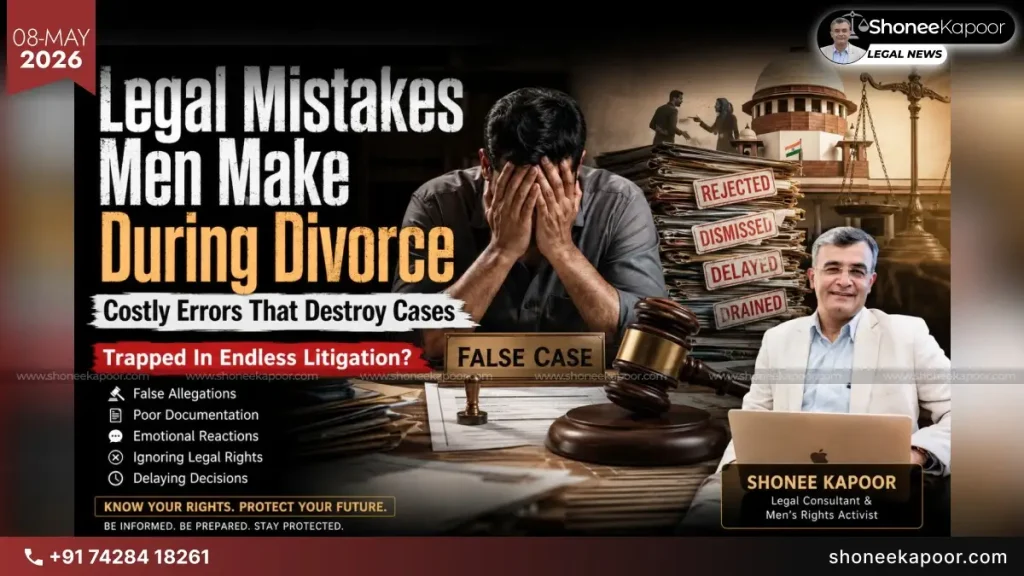
Costly legal mistakes Indian men make during divorce, maintenance, custody, 498A/BNS cruelty cases and evidence collection, with real Indian case laws.
NEW DELHI: Most men lose divorce battles not because the law gives them no remedy, but because they enter court emotionally, undocumented and badly advised.
Divorce is not only about ending a marriage. It is about evidence, pleadings, maintenance, custody, criminal defence, financial disclosure and timing. One careless WhatsApp message, one hidden bank account, one emotional settlement, or one badly drafted petition can cost a man years of litigation, lakhs of rupees and access to his child.
Under the Hindu Marriage Act, 1955, divorce can be sought under Section 13, while Sections 24, 25 and 26 deal with maintenance during proceedings, permanent alimony and child-related orders respectively. Maintenance can also arise under Section 144 of the Bharatiya Nagarik Suraksha Sanhita, 2023, which replaced the old Section 125 CrPC framework for maintenance of wives, children and parents.
Here are the most costly mistakes men make during divorce.
1. THINKING SILENCE WILL SAVE THEM
Many husbands believe that if they stay quiet, do not reply, and keep “adjusting”, the matter will settle.
That is the first trap.
Silence may look decent in society, but in court, silence often looks like admission. If allegations of cruelty, dowry demand, desertion, adultery, domestic violence or financial neglect are made, they must be answered with facts, dates, documents and evidence.
A man who does not preserve his defence early usually spends years repairing damage later.
2. FILING DIVORCE WITHOUT PROPER GROUNDS
Divorce is not granted because the husband is unhappy. It is granted when statutory grounds are proved.
For Hindus, cruelty under Section 13(1)(ia) of the Hindu Marriage Act is a common ground, but cruelty must be pleaded and proved with specific facts. General statements like “she tortured me” or “she never respected me” are weak unless backed by events, documents, witnesses, medical records, complaints, chats, emails or conduct.
In Samar Ghosh v. Jaya Ghosh, the Supreme Court laid down broad illustrations of mental cruelty. In K. Srinivas Rao v. D.A. Deepa, the Supreme Court disagreed with the High Court’s view that parties who did not live together could not cause cruelty to each other, and recognised that conduct including false criminal complaints may amount to mental cruelty in appropriate facts.
3. IGNORING FALSE CRIMINAL CASE RISK
Many men file divorce and assume the opposite side will only contest divorce.
That is naïve.
A divorce case may trigger allegations under old Section 498A IPC or now Section 85 BNS, domestic violence proceedings, maintenance claims, child custody disputes, dowry allegations and sometimes workplace or social complaints.
Section 85 BNS deals with cruelty by husband or his relatives; cruelty is defined separately under Section 86 BNS.
The Supreme Court in Arnesh Kumar v. State of Bihar held that arrest should not be automatic in 498A-type offences and police must satisfy legal requirements before arrest. But men still make the mistake of waiting casually until arrest becomes a real threat.
4. HIDING INCOME OR ASSETS
This is one of the most expensive mistakes.
Maintenance litigation is document-heavy. Courts examine income, liabilities, lifestyle, dependents, bank statements, ITRs, salary slips, property, loans and standard of living.
In Rajnesh v. Neha, the Supreme Court issued detailed maintenance guidelines and directed disclosure of assets and liabilities to bring transparency in maintenance proceedings.
A man who hides income may lose credibility permanently. Once credibility is lost, even genuine arguments become difficult to prove.
5. ASSUMING EDUCATED WIFE MEANS NO MAINTENANCE
Many husbands think, “She is educated, so she will not get maintenance.”
Wrong.
Education alone is not always enough. Courts look at actual earning, employability, past employment, present income, standard of living and dependence. At the same time, if the wife is genuinely earning well, that must be proved through documents, ITRs, employment records, bank entries, LinkedIn profile, professional registration, business details and lifestyle evidence.
A recent Allahabad High Court report noted denial of interim maintenance to a doctor-wife where tax records showed annual income of ₹31 lakh, while another recent Delhi court report noted that education alone does not automatically prove self-sufficiency.
The law does not work on assumptions. It works on proof.
6. FIGHTING CUSTODY EMOTIONALLY, NOT LEGALLY
Many fathers turn custody battles into emotional wars. That harms the child and the father’s case.
Custody is decided on welfare of the child, not ego of either parent. The father must document school involvement, medical care, financial support, emotional bonding, visitation denial, parental alienation and the child’s routine.
Courts increasingly criticise parents who use children as bargaining tools in matrimonial disputes. A recent Gujarat High Court report condemned the practice of using children as pawns in divorce wars.
A father must fight for custody and visitation with discipline, not anger.
7. LEAVING THE MATRIMONIAL HOME WITHOUT STRATEGY
Sometimes leaving the home is necessary for safety. But leaving without legal planning can create allegations of desertion, neglect, abandonment or refusal to maintain.
Before leaving, a man should preserve proof of circumstances: threats, abuse, complaints, medical records, audio/video where legally obtained, witnesses, messages and financial transfers.
Do not simply walk out and later say, “I was forced.”
Court asks: where is the proof?
8. SETTLING UNDER PRESSURE WITHOUT WRITTEN PROTECTION
Many men agree to oral settlements: “I will pay now, she will withdraw later.”
This is dangerous.
Every settlement must be written, specific and enforceable. It must cover divorce, maintenance, alimony, stridhan, child custody, visitation, pending FIRs, DV case, 125/144 maintenance, execution, quashing, withdrawal timelines and default consequences.
A vague settlement is not settlement. It is future litigation in disguise.
9. SENDING ANGRY MESSAGES
One abusive WhatsApp message can destroy months of legal work.
Men must understand that every message may become evidence. Threats, abuses, emotional blackmail, admissions, desperate apologies, suicide threats, payment promises and angry voice notes can all be used in court.
During divorce, communicate like every word will be read by a judge.
10. NOT PRESERVING DIGITAL EVIDENCE PROPERLY
Screenshots alone may not be enough in serious litigation. Preserve emails, chats, call logs, transaction records, photographs, metadata, cloud backups, original devices and certificates wherever required under evidence law.
Do not edit, crop, forward repeatedly or manipulate evidence. If evidence looks tampered, it becomes a liability.
11. DRAGGING PARENTS AND RELATIVES INTO EVERY FIGHT
A husband often involves parents emotionally, financially and legally. But matrimonial litigation can easily pull old parents, sisters, brothers-in-law and distant relatives into criminal complaints.
The Supreme Court in Preeti Gupta v. State of Jharkhand observed that some matrimonial complaints may be filed with oblique motives and courts must consider pragmatic realities.
Protect your family by keeping documentation, limiting unnecessary involvement and avoiding provocative communication.
12. TREATING MAINTENANCE AS PUNISHMENT INSTEAD OF LITIGATION
Maintenance is not a moral certificate. It is a legal claim.
A husband must contest maintenance with facts: actual income, wife’s income, liabilities, dependents, child expenses, standard of living, medical expenses and genuine financial capacity.
But he must not disobey court orders casually. Non-payment can lead to execution, coercive orders and loss of credibility.
13. NOT TAKING COUNTER-LEGAL REMEDIES
If allegations are false, a man should not only defend. He must evaluate legal remedies: quashing, discharge, anticipatory bail, perjury, defamation, restitution, custody, visitation, divorce on cruelty, complaint against false evidence, or appropriate civil/criminal action.
But counter-cases must be strategic, not emotional revenge.
14. CHOOSING SOCIAL MEDIA OVER COURT STRATEGY
Posting every dispute online may give temporary sympathy but can damage the case. Divorce litigation involves privacy, children, reputation and evidence.
Speak publicly only when legally safe. Do not publish confidential pleadings, child details or unverified allegations.
15. HIRING LATE AND EXPECTING MIRACLES
The biggest mistake: waiting until the case is already damaged.
Men come after arrest threat, after ex parte orders, after maintenance arrears, after missed deadlines, after bad admissions, after signing poor settlements.
Divorce strategy must begin before the first legal notice, not after the tenth court date.
FINAL WORD
A man in divorce litigation must stop behaving like a wounded husband and start behaving like a prepared litigant.
Emotion is not evidence. Anger is not strategy. Silence is not dignity. Poor documentation is self-destruction.
The man who records facts, preserves evidence, files correctly, discloses honestly, protects his child legally and contests false allegations with discipline has a fighting chance.
The man who reacts emotionally pays the cost.
FAQs
The biggest mistake is poor documentation. Without evidence, even genuine suffering becomes only a story.
Yes. Under Section 13(1)(ia) of the Hindu Marriage Act, mental cruelty can be a ground for divorce if properly pleaded and proved.
Yes, education alone does not automatically defeat maintenance. Actual earning capacity and financial independence must be proved.
In appropriate facts, false criminal complaints and reckless allegations may amount to mental cruelty, but the husband must prove falsity and impact.
Only with legal planning. Leaving without evidence and strategy may create allegations of desertion, neglect or abandonment.