
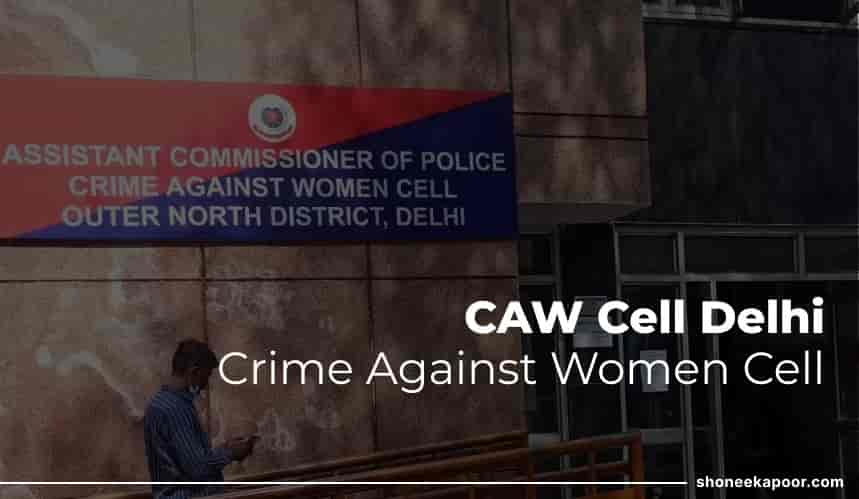
What is CAW Cell?
The Crime Against Women (CAW) Cell is also called Mahila Thana or Parivar Paramarsh Kendra in some states. These are special police units that help settle marriage-related problems, especially those related to dowry harassment (Section 498A IPC or Section 84 BNS) and domestic violence.
Their main goal is to help the husband and wife resolve their issues peacefully before any legal action is taken.
The first CAW Cell in Delhi was started in 1983 at Nanakpura under the Delhi Police Act, 1978.
What Does the CAW Cell Do?
The CAW Cell works mainly to counsel both the husband and wife in order to resolve their issues and try to save the marriage. It does not have the power to punish or arrest anyone directly. Instead, its role is to create a space where both parties can talk and attempt to settle their disputes peacefully. Only when these counselling efforts fail is the matter forwarded to the police for the registration of an FIR (First Information Report). The Delhi High Court has clarified that CAW Cells are not discriminatory. They are special units formed with the purpose of handling sensitive cases involving women in a careful and supportive manner.
Step-by-Step Procedure at CAW Cell (Delhi)
- Wife files a complaint in writing at the CAW Cell.
(Note: CAW Cell cannot act on its own. The woman must visit and submit the complaint.) - The CAW Cell checks the complaint and counsels the wife first.
- If she doesn’t want to withdraw the complaint, the husband is called by a request letter (not a legal summons).
- During the first visit, a counsellor tries to patch up things between husband and wife.
- If there’s a chance to save the marriage, more meetings are planned.
- If not, the wife is asked to give a list of her belongings (istridhan). The husband is asked to reply to that list by the next meeting.
- The counsellor writes down the details of each session. Both sides have to sign the report.
- Usually after 5 to 7 counselling sessions, if no solution is found, the CAW Cell forwards the case to its legal cell.
- The legal cell may suggest registering an FIR at the police station.
- At this stage, the husband should apply for anticipatory bail to avoid arrest.
Should the Husband Attend CAW Cell Sessions?
Yes. While it’s not compulsory, it’s very important to attend these meetings. If the husband doesn’t cooperate, it might become difficult to get bail later.
Also, the wife or her relatives might try to provoke the husband during meetings—stay calm and don’t react.
How Can You Get a Copy of the Complaint?
If you are the husband and wish to know what has been written in the complaint filed at the CAW Cell, you can obtain a copy by filing an application under the Right to Information (RTI) Act. This application should be addressed to the Public Information Officer (PIO) of the concerned CAW Cell. In your RTI, it’s helpful to include details such as the complaint number, the names of both parties, and the date of the complaint if known. The RTI application can be submitted either in person at the CAW Cell or sent by post.
Different Rules in Different States
The procedures followed by CAW Cells or police in matrimonial cases vary from state to state. In Punjab, Haryana, and Himachal Pradesh, the list of istridhan is not provided to the husband during the initial counselling. Instead, the police usually present it later while opposing the husband’s bail. In Uttar Pradesh, the FIR is registered first, and the couple is then given a 30-day period for reconciliation efforts. In Bihar and Jharkhand, most complaints are directly filed in court, and any counselling or settlement discussions typically take place during the bail hearing. In Maharashtra, there are no separate CAW Cells, and the FIR is generally registered immediately at the local police station without a preliminary counselling process.
Important Advice
- Don’t treat the CAW Cell like a court—avoid sharing all your proof at this stage.
- Even if the wife agrees during counselling, she can later change her statement.
- It’s smarter to save your evidence for the actual trial, not for CAW Cell meeting.
CAW Cell Delhi (Crime Against Women) – Full Address & Contact List
| S.No | Name of District | Address CAW Cell | Number of Social Worker | Contact Number CAW Cell |
|---|---|---|---|---|
| 1 | Headquarter (Nanakpura) | Special Police Unit for Women and Children, Nanakpura, Near Moti Bagh Gurudwara, New Delhi – 110021 | 01 | 011-26880393 |
| 2 | New Delhi | Crime Against Women Cell, 1st Floor, Police Station Mandir Marg, Near Birla Mandir, New Delhi – 110001 | 01 | 011-23740517 (Ext-3447) |
| 3 | East | D.C.P. Office, Mandawali Fazalpur, Gazipur, New Delhi – 110091 | 01 | 011-22232180 |
| 4 | North-East | Crime Against Women Cell, Old Police Station Nand Nagri Building, C-2 Block, Near Tanga Stand, Nand Nagri, New Delhi – 110093 | 01 | 011-22110604, 011-22110605 |
| 5 | Central | Crime Against Women Cell, 1st Floor, Police Station Kamla Market, Jawahar Lal Nehru Marg, Near Girdhar Lal Hospital, New Delhi – 110002 | 01 | 011-23233569 |
| 6 | North | Crime Against Women Cell, Ground Floor, Police Station Subzi Mandi, Near Hindu Rao Hospital, New Delhi – 110007 | 01 | 011-23828880 |
| 7 | South-East | Crime Against Women Cell, Sri Niwas Puri Police Post, Opposite Hatti Mandir, New Delhi – 110065 | 01 | 011-26841500 |
| 8 | Rohini | Crime Against Women Cell, Sec-3, Near JIMS Institute, Rohini, New Delhi – 110085 | 01 | 011-27511752, 011-27511753 |
| 9 | South | Crime Against Women Cell, 1st Floor Old Building, Police Station, Behind Anupam PVR, Saket, New Delhi – 110017 | 01 | 011-26562731 |
| 10 | Dwarka | Crime Against Women Cell, 1st Floor, New Building, Police Station Dabri, New Delhi | 01 | 011-25088987, 011-25089961 |
| 11 | Shahdara | Crime Against Women Cell, 1st Floor, Police Station | 01 | 011-22131082 |
| 12 | Outer | Crime Against Women Cell, Ground Floor, Police Line | 01 | 011-27017847 |
| 13 | South West | Crime Against Women Cell, Delhi Cantonment | 01 | 011-25681056 |
| 14 | West | Crime Against Women Cell, 1st Floor, Police Station | 01 | 011-25915314 |
| 15 | North West | Crime Against Women Cell, Near M2K Cinema, Rani Bagh, New Delhi – 110034 | 01 | 011-27015674, 011-27015675 |
| 16 | Outer North | Crime Against Women Cell, Sec-11, Rohini, Opposite Titiksha Public School, New Delhi – 110085 | 01 | NA |