
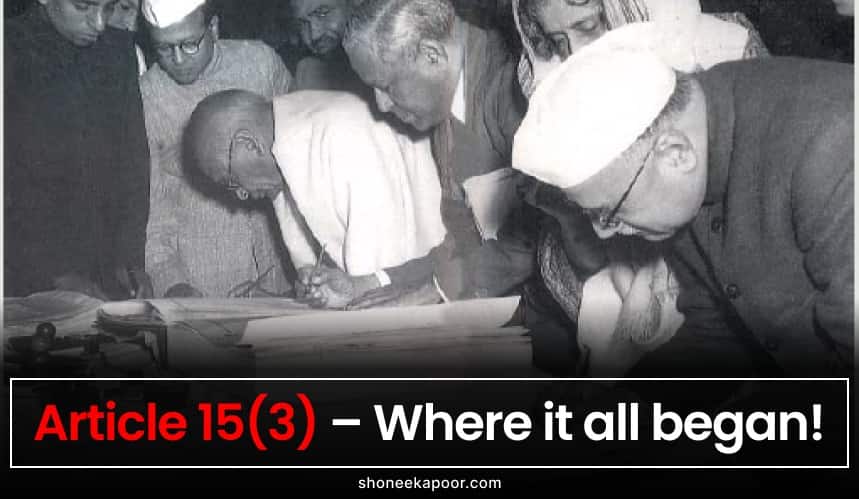
For an ordinary non-legal person, which most of men are prior to filing of dowry related cases against them, Articles 15(3) is the answer to their most basic yet generally misguided question. Clause 3 of Article 15 of the Constitution of India gives powers to the legislature to create special provisions for women and children. A bare act reading of A.15 (3) is “Nothing in this article shall prevent the State from making any special provision for women and children”.
Yet this seeming harmless and overall benevolent is the cause of all the “women/wife” centric laws in India. For understanding how laws are made, please read the article by the same name here, however how those laws are fueled is what you can understand by a casual reading of the table below. This table is available at www.wcd.nic.in (Direct Link) and provides us information about the Budget outlays and actual expenditure for Ministry of Women & Child Development. Just in last 10 years, they have spent over 1 Lakh crores on various schemes and grants-in-aid. This has mostly been made possible because of that seeming “beneficial piece of legislation” mentioned above.
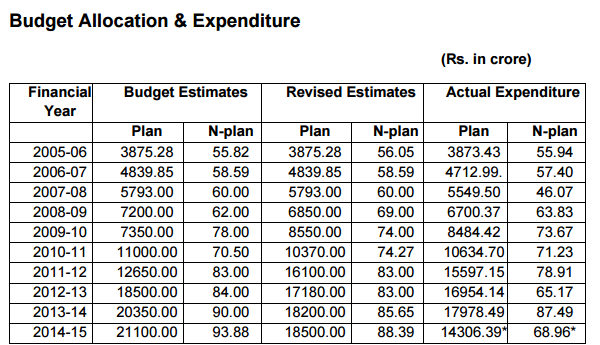
*upto 31.12.2014
For understanding how this piece of legislation is actually escapes the eyes of casual reader, it is important to understand the Article 14 and Article 15, which truly signify the principles of equality and prohibit discrimination. The text of both Articles is reproduced below:
Article 14: Equality before law The State shall not deny to any person equality before the law or the equal protection of the laws within the territory of India Prohibition of discrimination on grounds of religion, race, caste, sex or place of birth
Article 15: Prohibition of discrimination on grounds of religion, race, caste, sex or place of birth A logical question which comes to the mind of a reader would be the inclusion of word “sex”. So either this word should not be part of the equality or it should not be used to discriminate using Clause 3 of Article 15.
Clause 3 of Article 15 of the Constitution of India, has been widely resorted to and courts have upheld the validity of special measure in legislation or executive orders favoring women. In particular, provisions in the criminal law in favor of women or in the procedural law have been upheld by the court.
Though there have been discussions and court decisions in regards to the “creamy layer” to be taken out of the exceptions provided under Clause 4 of Article 15, no such opposition can be even thought of in the era of “Vote Bank” politics. The same politicians who had created a these so called beneficial legislations, have seen the most unprecedented scenes in Rajya Sabha, when members tried to attack Vice-President and Rajya Sabha Chairman and disrupted tabling of the Bill.
A senior member of a political party went on to say “Do you think these women with short hair can speak for women, for our women…”. Though the representation of women is at 12% in Lok Sabha (People’s House) and women reservation bill is blocked for nearly 20 years after it was introduced, the court had no hesitation in upholding reservation of seats for women in local bodies and education institutions {Dattatra v. State of Bombay, AIR 1953 Bom 311}. WHEREAS, In 24 state high courts, nine HCs do not have a single woman judge. Three High Courts have only one woman judge.
There are 62 women judges compared to 611 male judges (in High Courts) in the entire country. The figures from Supreme Court of India are even more shocking, only six women judges on its august benches since its inception in 1950.
One thing the author would like to point is that as for the Judiciary, we are answered that there are not enough competent judges to be elevated. Can this situation be any different when it comes to representatives of people.
Something which cannot be overlooked is that even in local bodies, though the reservation for women has meant that their husbands run day to day affairs from the background and the representative is a mere prop. The whole state has been run by a shadow chief minister and that speaks volumes about such so called call for reservation.
While the common man is facing the brunt of these gender-biased laws, the citadels of power are ensuring they keep themselves “above” by either doling out vast amount funds or declaring the validity of women centric laws and reservations.