
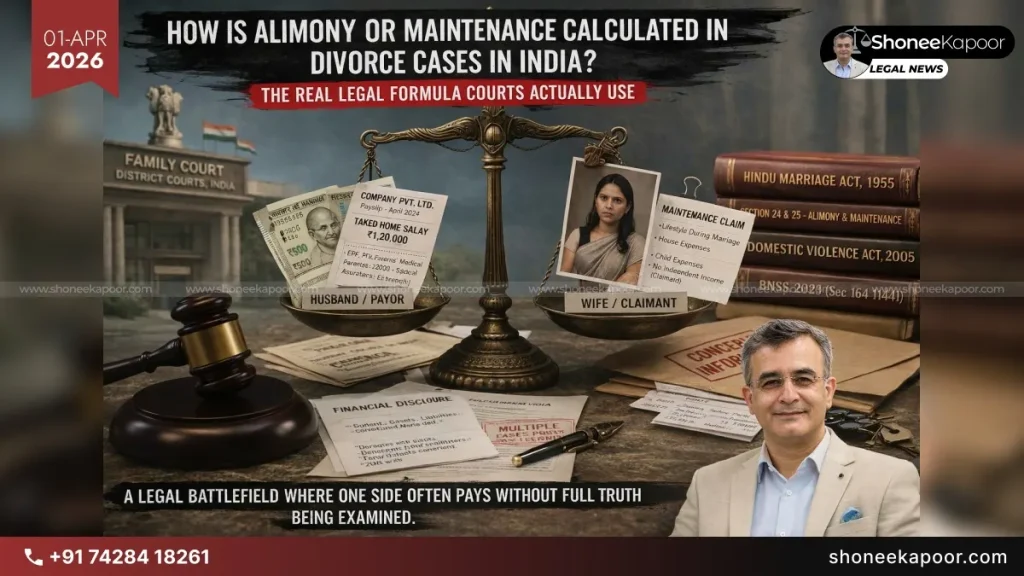
Is alimony really fixed at 25% or decided randomly by courts? Or is there a deeper legal method that most people still don’t understand?
NEW DELHI: In India, the biggest myth in divorce law is that maintenance is calculated by some fixed formula. It is not. There is no universal 25% rule, no automatic half-salary rule, and no one-size-fits-all number.
The Supreme Court has made it clear that there is “no straitjacket formula” for fixing maintenance, and that the object is to prevent destitution, not to punish the other spouse.
That is exactly why so many men walk into family litigation unprepared. They assume alimony is random. It is not random, but it is highly fact-based. Courts look at income, assets, liabilities, lifestyle during marriage, reasonable needs, dependants, child expenses, litigation costs, and even concealment of finances. In short, maintenance is not guessed in the air. It is built from documents, disclosures, and judicial discretion.
Under Hindu law, Section 24 of the Hindu Marriage Act, 1955 allows either the wife or the husband to seek interim maintenance and litigation expenses if that party has no sufficient independent income.
Section 25 allows either spouse to seek permanent alimony, either as a lump sum or periodic payment, and the court can consider the income and property of both sides, the conduct of the parties, and other circumstances of the case. The court can later vary, modify, or rescind that order if circumstances change.
For marriages under the Special Marriage Act, 1954, Section 36 provides alimony pendente lite, and Section 37 provides permanent alimony and maintenance. But unlike the Hindu Marriage Act, the statutory language here is wife-centric. The court considers the wife’s property, the husband’s property and ability, the conduct of the parties, and other circumstances.
For Parsis, Sections 39 and 40 of the Parsi Marriage and Divorce Act, 1936 permit interim and permanent alimony, and these provisions are available to either spouse. The statute expressly speaks of the income and property of both parties, conduct, and surrounding circumstances.
For Christians, Sections 36 and 37 of the Divorce Act, 1869 govern alimony pendente lite and permanent alimony. The statutory text remains wife-centric and directs the court to consider the wife’s fortune, the husband’s ability, and the conduct of the parties.
Alongside personal laws, India also has the secular maintenance route. Since 1 July 2024, the old Section 125 CrPC framework stands replaced by Section 144 of the Bharatiya Nagarik Suraksha Sanhita, 2023. That provision covers maintenance of wives, children and parents where a person with sufficient means neglects or refuses to maintain them. So today, when lawyers casually say “125 CrPC maintenance,” the updated statutory reference is BNSS Section 144 for new matters.
There is also the Protection of Women from Domestic Violence Act, 2005. Section 20 allows the Magistrate to award monetary relief, including maintenance for the aggrieved woman and her children, and the statute says such relief must be “adequate, fair and reasonable” and consistent with the standard of living to which she was accustomed. It can be a lump sum or monthly payment.
So how do courts actually calculate the amount?
The Supreme Court’s decision in Rajnesh v. Neha is the starting point. The Court said maintenance must account for the status of the parties, the reasonable needs of the claimant and dependent children, whether the applicant has any independent income, the respondent’s actual income, reasonable personal expenses, legal liabilities toward other dependants, the standard of living in the matrimonial home, inflation, and the realities of modern living.
The Court also said maintenance should be realistic: neither oppressive for the payer nor so meagre that it drives the claimant to penury.
This is where many maintenance battles are won or lost. Courts do not simply look at salary slips. They look at the complete financial picture: salary, business income, rental income, movable and immovable assets, investments, loan liabilities, education of children, medical expenses, and the actual family lifestyle.
In Rajnesh v. Neha, the Supreme Court went further and made financial disclosure affidavits mandatory in maintenance proceedings across the country. That means income hiding is no longer supposed to be brushed aside as routine matrimonial strategy.
The Court also recognised a practical truth that matters in real litigation: when finances are concealed, “some guess work is not ruled out.” That line is critical. It means suppression of income can backfire badly. If a husband under-discloses, the court may draw adverse inferences. If a claimant suppresses income, assets, employment, or prior maintenance orders, that too can damage the claim. Maintenance litigation is not supposed to be a blind sympathy exercise. It is supposed to be evidence-based.
Another major myth is the so-called “25% rule.” The Supreme Court in Kalyan Dey Chowdhury v. Rita Dey Chowdhury referred to 25% of the husband’s net salary as just and proper in the facts of that case. But even that order itself says maintenance always depends on the factual situation of the case, and the court may mould the claim based on various factors. So 25% is not a universal formula. It is a case-specific benchmark that lawyers often misuse as if it were statutory law. It is not.
The same position is reinforced by the Supreme Court’s broader maintenance jurisprudence. In Rajnesh v. Neha, the Court cited Manish Jain v. Akanksha Jain and recorded that the financial position of the wife’s parents is not material in determining maintenance.
The Court also noted that merely saying the wife is educated is not a complete answer to a maintenance claim. At the same time, the judgment requires a careful balance with the husband’s actual income, expenses, liabilities, and dependants. That balancing exercise is where proper legal strategy matters.
One more important point: maintenance can run in parallel under different statutes, but double recovery is not the legal objective. In Rajnesh v. Neha, the Supreme Court directed that if there is a previous maintenance order, it must be disclosed in the later case, and the later court should consider adjustment or set-off.
The Court specifically noted that it would be inequitable to make a husband pay maintenance independently under every proceeding without accounting for what is already awarded elsewhere.
That is why the real answer to “how is alimony calculated?” is this:
Indian courts do not use a fixed mathematical formula. They use a fact-sensitive judicial formula. The stronger the documents, the clearer the disclosures, and the more honest the financial record, the more predictable the result. The weaker the disclosure and the more tactical the concealment, the more dangerous the outcome.
From a men’s rights perspective, this is exactly why husbands should stop relying on social media myths and start preparing evidence early. Bank statements, ITRs, EPF records, EMI burden, dependent parents, medical costs, rent, prior settlements, children’s actual expenses, and the claimant’s own earnings or assets can change the result drastically. Maintenance is not supposed to be extortion by allegation. It is supposed to be a judicial assessment based on law and proof.
FAQs
No. Indian courts do not follow a universal percentage formula. They assess facts, income, assets, liabilities, standard of living, and needs of dependants.
No. The Supreme Court mentioned 25% in one case on its own facts, but it is not a statutory rule for every divorce case.
Yes, under Section 24 and Section 25 of the Hindu Marriage Act, either spouse may seek interim or permanent alimony if the statutory conditions are met. Under the Parsi Act too, either spouse can apply.
Yes, but earlier orders must be disclosed, and later courts should consider adjustment or set-off to avoid unfair duplication.
For new criminal-procedure maintenance matters, the updated provision is Section 144 of the Bharatiya Nagarik Suraksha Sanhita, 2023, in force from 1 July 2024.