
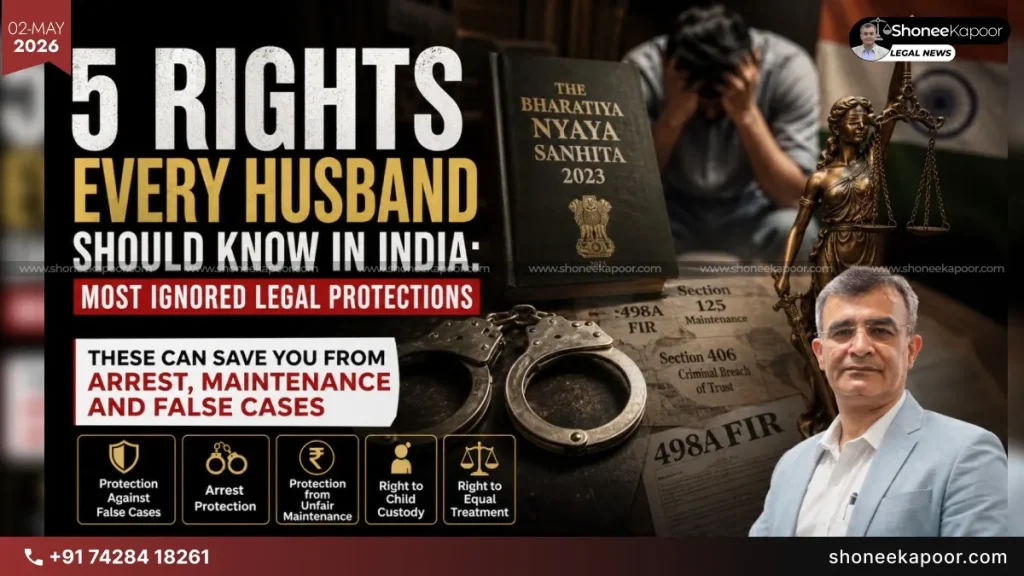
Every Indian husband must know these 5 ignored legal rights in 498A, maintenance, arrest, custody and false matrimonial cases.
NEW DELHI: Most husbands enter litigation too late. They react after FIR, arrest threat, maintenance notice, child separation, orfalse allegations. The truth is simple: Indian law is not only about allegations; it is also about procedure, evidence, defence, and rights.
Here are 5 legal rights every husband in India must know before matrimonial litigation destroys his liberty, reputation and family life.
1. RIGHT AGAINST AUTOMATIC ARREST IN 498A / CRUELTY CASES
A husband cannot be arrested mechanically just because a wife has filed a cruelty case.
Earlier, cruelty by husband or relatives was under Section 498A IPC. Under the new criminal law, it is now covered under Sections 85 and 86 of the Bharatiya Nyaya Sanhita, 2023, where cruelty is punishable with imprisonment up to three years and fine.
In Arnesh Kumar v. State of Bihar, the Supreme Court made it clear that arrest is not automatic in offences punishable up to seven years. Police must satisfy legal conditions before arrest.
Under Section 35 BNSS, if arrest is not required, police must issue notice of appearance. If the person complies, he shall not be arrested unless reasons are recorded.
Ignored truth: Notice is not a formality. It is a legal shield. Never ignore it. Always appear through proper legal strategy.
2. RIGHT TO CHALLENGE MAINTENANCE WITH INCOME, ASSETS AND LIABILITIES
Maintenance is not charity. It is decided on evidence.
In Rajnesh v. Neha, the Supreme Court laid down guidelines for financial disclosure in maintenance cases. Courts must consider income, assets, liabilities, standard of living, dependents and previous maintenance orders.
The husband has the right to demand full financial disclosure from the wife. If she is earning, hiding income, suppressing assets, or filing multiple maintenance cases, that must be brought before the court.
However, the law is balanced. Merely saying that the wife is educated is not enough. In Chaturbhuj v. Sita Bai, the Supreme Court held that the test is whether the wife can maintain herself in the manner consistent with the status of the family.
Ignored truth: Maintenance cases are won with documents, not emotions.
3. RIGHT TO CHILD VISITATION AND CONTACT
A father is not an ATM. A father is a parent.
In Yashita Sahu v. State of Rajasthan, the Supreme Court held that even if one parent gets custody, the other parent must normally get meaningful visitation and contact rights. Denial of contact should happen only in extreme circumstances, and courts must give reasons.
The Court stressed that the child should not lose social, physical and psychological contact with either parent.
Ignored truth: If custody is denied, visitation must be fought immediately. Delay allows alienation to become normal.
4. RIGHT TO QUASHING OF VAGUE AND OMNIBUS ALLEGATIONS
Not every family member can be dragged into a criminal case without specific allegations.
In Kahkashan Kausar v. State of Bihar, the Supreme Court warned against casually implicating relatives in matrimonial disputes through general and omnibus allegations. Such misuse can be checked through quashing where allegations lack specific role and material.
This principle is vital in 498A-type cases where aged parents, married sisters, brothers, and distant relatives are often named only to create pressure.
Ignored truth: A vague FIR is not the end. It can be attacked legally.
5. RIGHT TO DEFEND WITH EVIDENCE, CONTRADICTIONS AND PERJURY STRATEGY
A husband has the right to collect and use lawful evidence: chats, bank records, travel records, medical records, call details through court process, photographs, emails, previous complaints, and contradictions in statements.
Under modern criminal law, electronic evidence has become even more important. The husband must preserve original devices, backups, metadata, and certificates wherever required.
False allegations are not defeated by shouting “false case.” They are defeated by contradictions.
Ignored truth: In matrimonial litigation, the man who documents survives. The man who only explains suffers.
FINAL WORD
Indian husbands must stop entering court like victims and start entering court like litigants.
The law gives rights. But rights are useless if you do not invoke them at the right stage.
In 498A, maintenance, custody, the Domestic Violence Act, false rape allegations, dowry allegations or divorce litigation, the first mistake of most men is silence. The second mistake is emotional reaction. The third mistake is poor documentation.
A husband must know the law before the case knows him.
FAQs
Not automatically. Arrest must satisfy legal conditions, and notice under Section 35 BNSS may apply where arrest is not required.
Yes, if her income is insufficient to maintain the marital standard of living. But the husband can challenge concealment, income, assets and liabilities.
Yes. The Supreme Court has held that a child should normally maintain contact with both parents.
Yes, where allegations are vague, omnibus and without specific role, quashing can be sought.
They react emotionally and fail to preserve evidence. Documentation is often the difference between defence and destruction.